



The Evolution of Office Management Models and the Path to Enterprise Digital-Intelligent Empowerment & AI Transformation
For corporate decision-makers, company management is far more than just "finance, customers, storage, and sales." It permeates cash flow, operational efficiency, and customer satisfaction, serving as one of the core lifelines determining a company’s competitiveness. From the "blind men touching an elephant" reliance on manual experience to today’s data-driven, intelligently warned "panoramic insight," the evolution of office systems is a condensed history of enterprise management technology.
Understanding this journey not only helps us see the path taken but also enables us to accurately grasp how to leverage next-generation AI-powered office systems like Kuailu Cloud to achieve genuine digital-intelligent transformation and upgrade, building future-oriented core competitiveness.
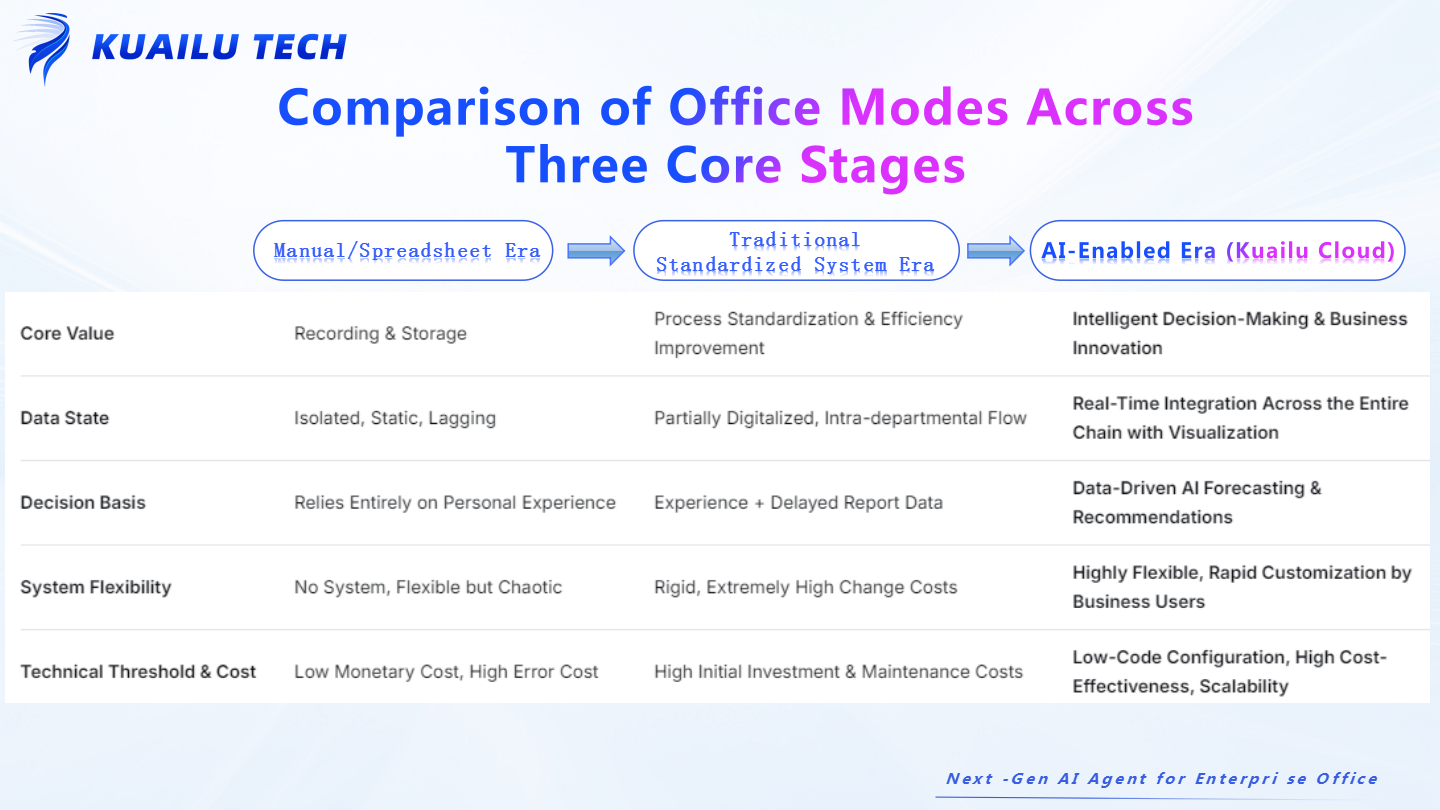
I. Chaos and Enlightenment—The Era of Manual Records and Spreadsheets
Before the wave of informatization, enterprise management long resided in the "manual era." The core characteristics of this stage were high reliance on manpower, paper-based workflows, and data silos.
The Dilemma of Paper Documents:
All critical information, such as inbound and outbound records, relied on handwriting, and financial ledgers required manual transcription and calculation. This led to extremely low data accuracy, where "book numbers," "actual numbers," and "report numbers" often failed to align. Year-end inventory counts turned into massive and painful error-correction campaigns. Information flow was slow, and management decisions heavily depended on the personal memory and experience of warehouse staff, resulting in prominent management loopholes and "information silo" phenomena.
The Preliminary Revolution of Excel:
With the proliferation of personal computers, Excel spreadsheets became the starting point for digital management in many enterprises. They addressed some inefficiencies and error-prone aspects of manual statistics, achieving electronic data storage. However, Excel was essentially "advanced paper and pen." Its shortcomings—poor data security, difficulties in multi-person collaboration, and challenges in process automation—became glaring as business volume grew. Issues like version confusion and untraceable data emerged as new pain points.
During this period, enterprises’ understanding of inventory also underwent profound changes. According to the development of inventory theory, early enterprises once viewed inventory merely as a symbol of "assets." After lessons from economic crises, it was seen as a "grave." It wasn’t until the rise of scientific management thinking that enterprises began systematically seeking a balance between inventory costs (holding costs) and ordering costs, exemplified by the famous Economic Order Quantity (EOQ) model. This marked the beginning of enterprise office management transitioning from intuition to rationality.
II. Order and Efficiency—The Rise of Traditional Standardized Inventory Management Systems
To address the complexities brought by scale and cross-regional operations, specialized inventory management software and integrated ERP (Enterprise Resource Planning) systems emerged, ushering enterprise management into the "systematic era."
The core value of this stage was "process standardization" and "data digitization." Systems solidified key processes such as procurement, sales, inbound, and outbound operations, reducing human arbitrariness. Data flowed electronically across departments, enabling basic business collaboration and significantly improving inventory accuracy and order processing efficiency.
However, traditional systems also had their historical limitations, mainly reflected in:
! Rigidity and High Barriers !:
System functional modules were fixed. Once business processes required adjustment or innovation, modification costs were extremely high, cycles were lengthy, and expensive custom development was often necessary.
! Persistent Data Silos !:
Many systems were only locally deployed or functionally closed, making integration with other business systems (e.g., CRM, financial software) difficult and failing to fully connect data chains.
! Weak Decision Support !:
Systems primarily addressed "recording" and "process" issues but still relied on managerial experience for decision-making questions like "why to purchase," "how much to purchase," and "how to optimize inventory structure," lacking intelligent data insight support.
III. Insight and Evolution—The Era of AI-Empowered Intelligence
The breakthrough in the era of AI intelligent systems lies in leveraging AI algorithms to deeply mine business data value, enabling prediction, warning, and automated decision-making.
✔ Intelligent Forecasting and Replenishment:
The system can comprehensively analyze multi-dimensional information such as historical sales data, seasonal trends, market activities, and even weather to dynamically forecast future demand and automatically generate precise procurement suggestions, fundamentally reducing the risks of stockouts and overstocking.
✔ Dynamic Risk Prevention and Control:
By setting intelligent warning rules (e.g., inventory thresholds, expiration dates, supplier qualifications), the system can monitor anomalies in real time, shifting from passive response to proactive intervention.
✔ Deep Integration of Business and Finance:
Procurement, sales, and inventory change data can be synchronized in real time and automatically generate financial vouchers, thoroughly addressing the pain points of disconnection between business and financial data and cumbersome reconciliation, achieving a fusion of "business as finance."
Kuailu Cloud’s Paradigm Innovation: The Synergy of AI + Low-Code
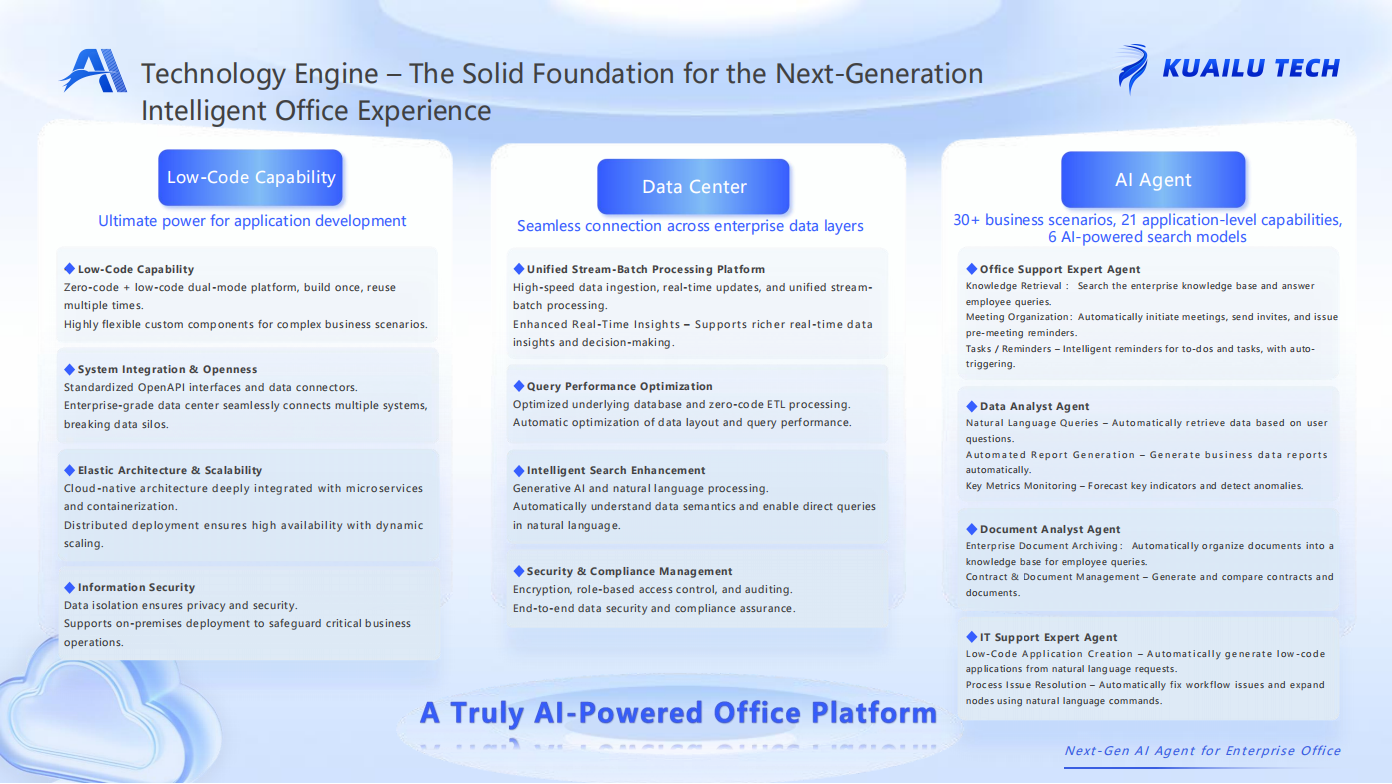
The Kuailu Cloud AI Intelligent Office System not only integrates the aforementioned AI capabilities but also addresses the core pain points of traditional systems—"rigidity" and "high costs"—through an "All-in-One" product design philosophy and a low-code platform.
✔ All-in-One Integrated Experience:
It deeply integrates functions such as inventory management, finance, customer management, and collaborative office work into a single platform, avoiding the hassles of switching between multiple isolated systems and data integration.
✔ Low-Code Empowering Business Autonomy:
Its low-code development platform allows business personnel to quickly customize forms, workflows, and reports through visual drag-and-drop, without relying on IT departments for lengthy development. This means the system can adapt to enterprises’ unique management needs at extremely low costs and high speed, flexibly adjusting as the business grows.
✔ Data Hub:
Connects underlying enterprise data with a stream-batch integrated processing platform, enabling high-speed data ingestion, real-time updates, and stream-batch integrated processing to support richer real-time data insights and decision-making.
✔ Deeply Embedded AI Agents:
Equipped with cutting-edge office AI agents to automate tedious processes, intelligently analyze and make decisions, fully unleashing team creativity. Functions include AI intelligent search, AI intelligent form filling, AI intelligent document management, AI intelligent data analysis, AI intelligent IM, AI intelligent schedule management, AI intelligent reminders, AI intelligent meeting organization, AI intelligent meeting minutes, and narrowband HD meeting capabilities, ensuring enterprise data security, traceability, and non-deletability.
IV. Trends and the Future: How AI Intelligent Office Systems Reshape Enterprise Competitiveness
✔ Internet of Things (IoT) and Automation:
The proliferation of RFID, smart sensors, AI intelligent systems, and automated warehouse robots will achieve comprehensive automation from data entry to physical operations, realizing "AI agent" smart warehouses.
✔ End-to-End Traceability and Trust Building:
The application of end-to-end technology promises to provide tamper-proof, full-process traceability records for goods from production to consumption, particularly suitable for industries such as food, pharmaceuticals, and luxury goods, enhancing supply chain transparency and trust.
✔ From Tool to Ecosystem:
AI intelligent office systems will further open up, becoming supply chain collaborative ecosystem platforms connecting suppliers, logistics providers, distributors, and customers, enabling real-time sharing and dynamic optimization of demand, inventory, and capacity information.
V. The Imperative for Enterprise AI Empowerment and Transformation: Insights from Authoritative Institutions and Industry Leaders
This transformation trend has gained consensus from global authoritative institutions and is being implemented by top enterprises.
▶ According to Microsoft’s "2025 Work Trend Index," up to 82% of enterprise executives plan to integrate intelligent agents as ‘digital colleagues’ into core business operations in the near future, marking AI’s transition from an auxiliary tool to a ‘knowledgeable and task-accomplishing’ business partner.
▶ The China Academy of Information and Communications Technology (CAICT) explicitly lists ‘intelligent agent applications’ as a core keyword for digital-intelligent transformation in government and enterprises, noting their deep penetration into various industry business scenarios.
▶ Zhang Qingyuan, CEO of Kingsoft Office, points out that future office systems will become ‘containers of knowledge’ and ‘carriers of digital employees,’ aiming to build an organizational ‘enterprise brain.’
▶ An IBM industry survey report indicates that in 2025, 46% of surveyed executives plan to optimize processes by expanding AI applications, directly echoing enterprises’ core demands for leveraging AI for "process optimization" and "efficiency improvement."
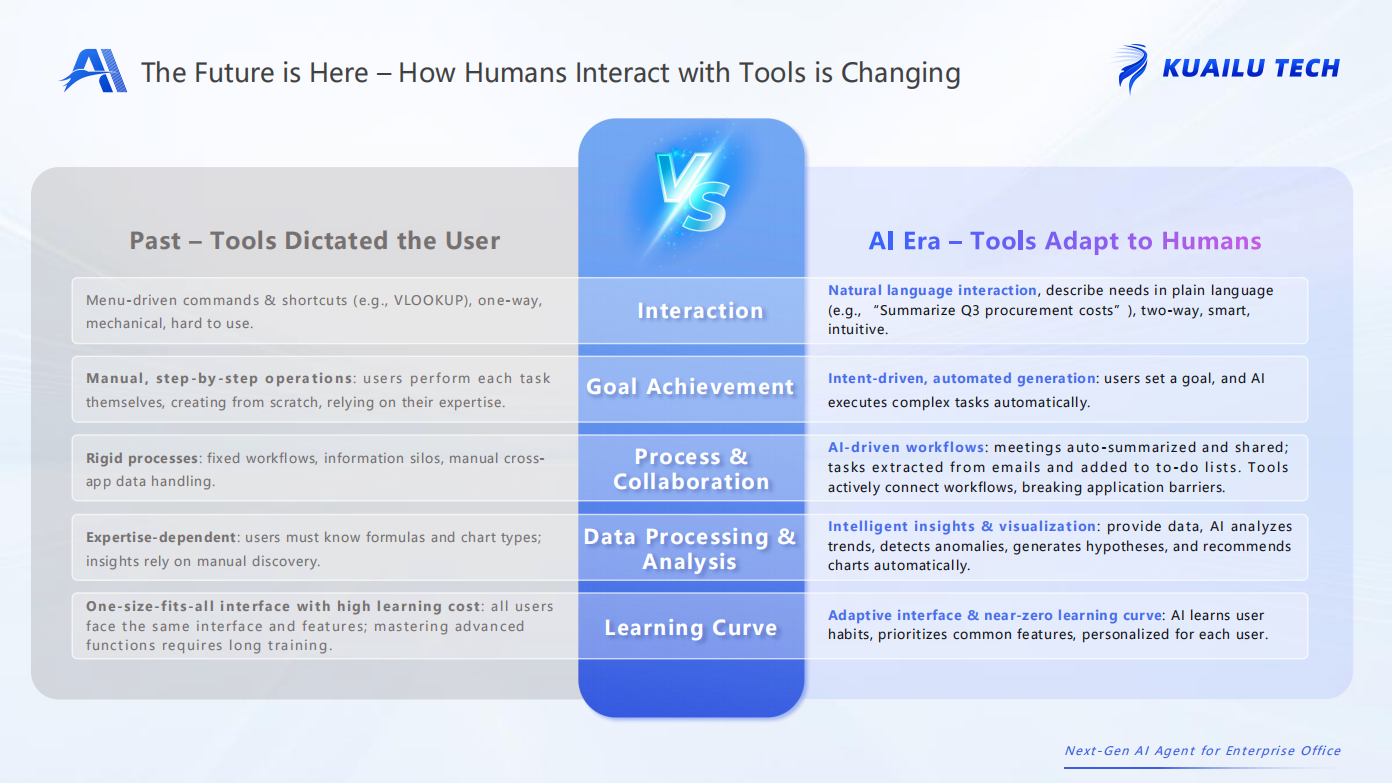
These consistent judgments from decision-makers, research institutions, and practitioners strongly indicate that leveraging AI to build ‘AI intelligent office systems’ like Kuailu Cloud is no longer merely about efficiency optimization but a strategic reshaping crucial for future survival and development.
The history of office model evolution clearly shows that enterprise development management is transitioning from a cost center to a strategic core driving growth and creating value. For decision-makers seeking transformation and upgrade, now is the critical moment to embrace change.
From paper carrying information to algorithms generating wisdom, every leap in office management tools has profoundly reshaped the operational logic of the business world. In the wave of digital-intelligent transformation, proactively embracing next-generation systems like Kuailu Cloud, equipped with an AI core and flexible architecture, is no longer an optional efficiency booster but a necessary path to building enterprises’ future survival and development rights.