



The More Mature the Systems, the Harder the Transformation? Kuailu AI Domain Expert Empowers Enterprises with Painless Digital Intelligence Transformation
I. Kuailu Intelligent Office Industry Insight: The "System Paradox" of AI Transformation in Large Enterprises
Over the past three years, enterprise-grade AI applications have evolved rapidly from concept to implementation. However, in the process of serving more than 200 large and medium-sized enterprises, a pervasive issue has emerged: the more mature an enterprise's information infrastructure, the greater the difficulty of AI transformation. Behind this phenomenon lie three layers of structural resistance.
1. Data Fragmentation Caused by System Heterogeneity:
The IT architecture of large enterprises typically consists of systems from multiple vendors, built on diverse codebases and protocols—HR systems may be deployed on SAP, financial accounting runs on Yonyou NC, supply chain management relies on Kingdee Cloud, collaboration is based on Weaver or Lanling, and CRM uses Salesforce. Each system was built independently, implemented in phases, and iterated separately. While each possesses deep capabilities within its domain, cross-system data retrieval and business collaboration have long relied on manual effort. Industry research indicates that knowledge workers spend approximately 19% of their daily working hours searching across systems and integrating data.
2. Sharply Escalating Costs of System Upgrades:
When enterprises attempt to introduce AI capabilities, they typically face two options: either replace core systems to gain native AI support—an investment often reaching tens of millions with associated business interruption risks—or achieve data interoperability through API development. However, within heterogeneous IT architectures comprising systems from multiple vendors and codebases, API development is characterized by long cycles and high complexity—each additional system connection leads to an exponential increase in the number of interfaces, with development timelines, technical debt, and ongoing maintenance costs far exceeding initial expectations. A significant number of enterprises find themselves trapped in the decision-making dilemma of "wanting to transform but afraid to act."
3. The Lock-in Effect of Organizational Inertia and Operational Habits:
Long-term use of mature systems has established stable user operational habits and muscle memory. The introduction of any new tool—no matter how powerful—requires a learning curve, an adaptation period, and a restructuring of usage habits. This entails not only increased training costs but also short-term fluctuations in organizational efficiency and subtle resistance from employees.
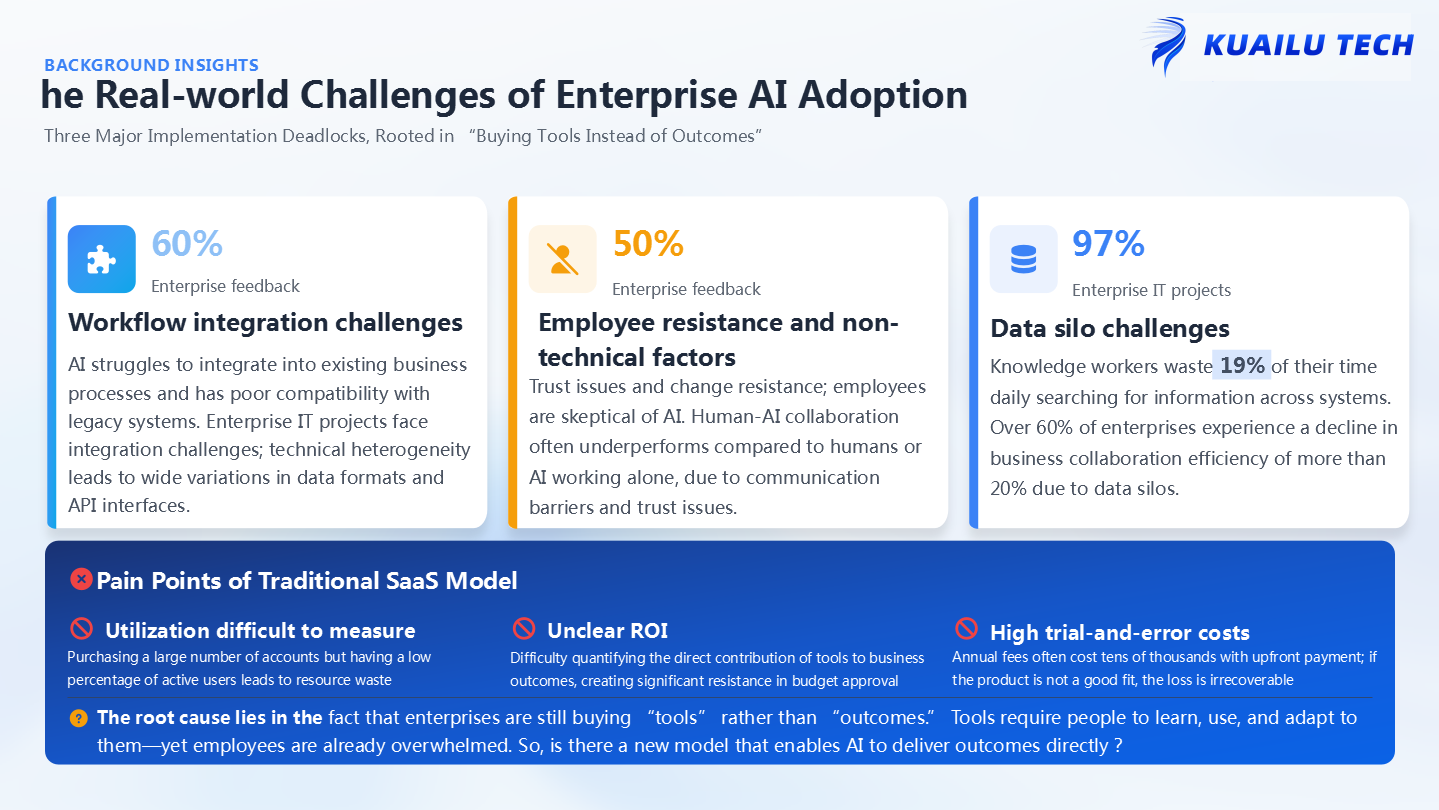
These three layers of resistance collectively point to a core conclusion: Large enterprises do not need to "replace existing systems," but rather to "build an intelligent orchestration layer that can govern heterogeneous systems"; they do not need to "make employees learn new tools," but rather to "integrate AI into employees' existing operational interfaces."
Kuailu AI Domain Expert's Solution Approach:
By establishing a data connectivity layer independent of individual business systems, it enables data integration across heterogeneous systems through a non-invasive connection approach. Enterprises are not required to modify any existing system interfaces or data structures. AI can then achieve unified orchestration of multi-source data and automated execution of cross-system tasks, compressing the high costs and complex cycles associated with traditional system integration into a lightweight solution featuring hour-level deployment and zero-code configuration.II. Product Positioning: The Design Logic Behind Kuailu AI Domain Expert
Based on deep insights into the AI transformation challenges faced by large enterprises, Kuailu Intelligent Office officially launched the Kuailu AI Domain Expert in 2026—a digital employee solution characterized by its non-invasive connection approach.
The product's core design logic can be summarized by the "Three No's" principle:
No Replacement: All existing systems (ERP, CRM, OA, finance, databases, etc.) remain fully intact, protecting the enterprise's prior information technology investments.
No Modification: No API refactoring, data migration, or business process re-engineering is required. The data connectivity layer enables unified access and data integration for heterogeneous systems.
No Retraining: Employees interact with AI capabilities by simply using the "@" function within their existing IM platforms (Feishu, WeCom, DingTalk, Teams, etc.), incurring zero learning costs and experiencing no perceptible change to their operational interface.
III. Permission Control: The Security Foundation for Enterprise AI Applications
When deploying AI applications, large enterprises prioritize security, controllability, and auditability. The Kuailu AI Domain Expert incorporates a comprehensive permission control system to ensure a balance between usability and control.
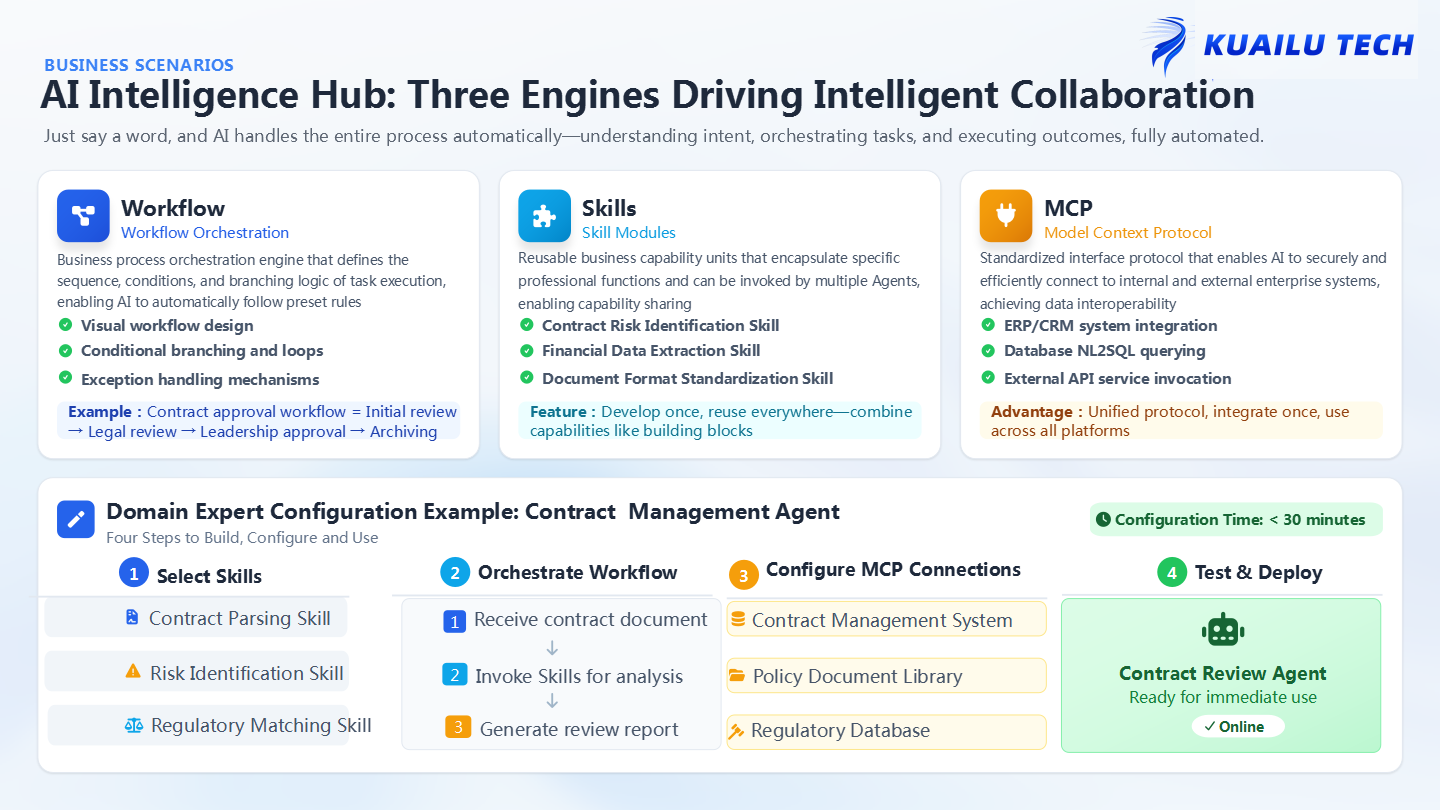
Multi-Level Permission Architecture: Supports configuring the systems and data accessible by Kuailu AI Domain Expert across multiple dimensions, including department, position, role, and data domain. Kuailu Financial Management Expert can only access financial systems and related databases, while Kuailu Human Resources Expert has no authorization to retrieve contract, financial, or other sensitive data, ensuring precise isolation of sensitive information and preventing data leakage.
Dynamic Permission Control: Before executing sensitive operations, the AI automatically verifies the requester's permissions. If permissions are insufficient, the AI either rejects the execution or automatically initiates a permission request workflow, continuing only after the leader approves it within the IM platform.
End-to-End Operational Audit: Every AI invocation, data access, and instruction execution generates an immutable operation log, forming a fully traceable "person-instruction-result" closed loop that meets state-owned asset regulatory and internal audit requirements.
IV. Application Scenarios: Core Capabilities Across Six Specialized Domains
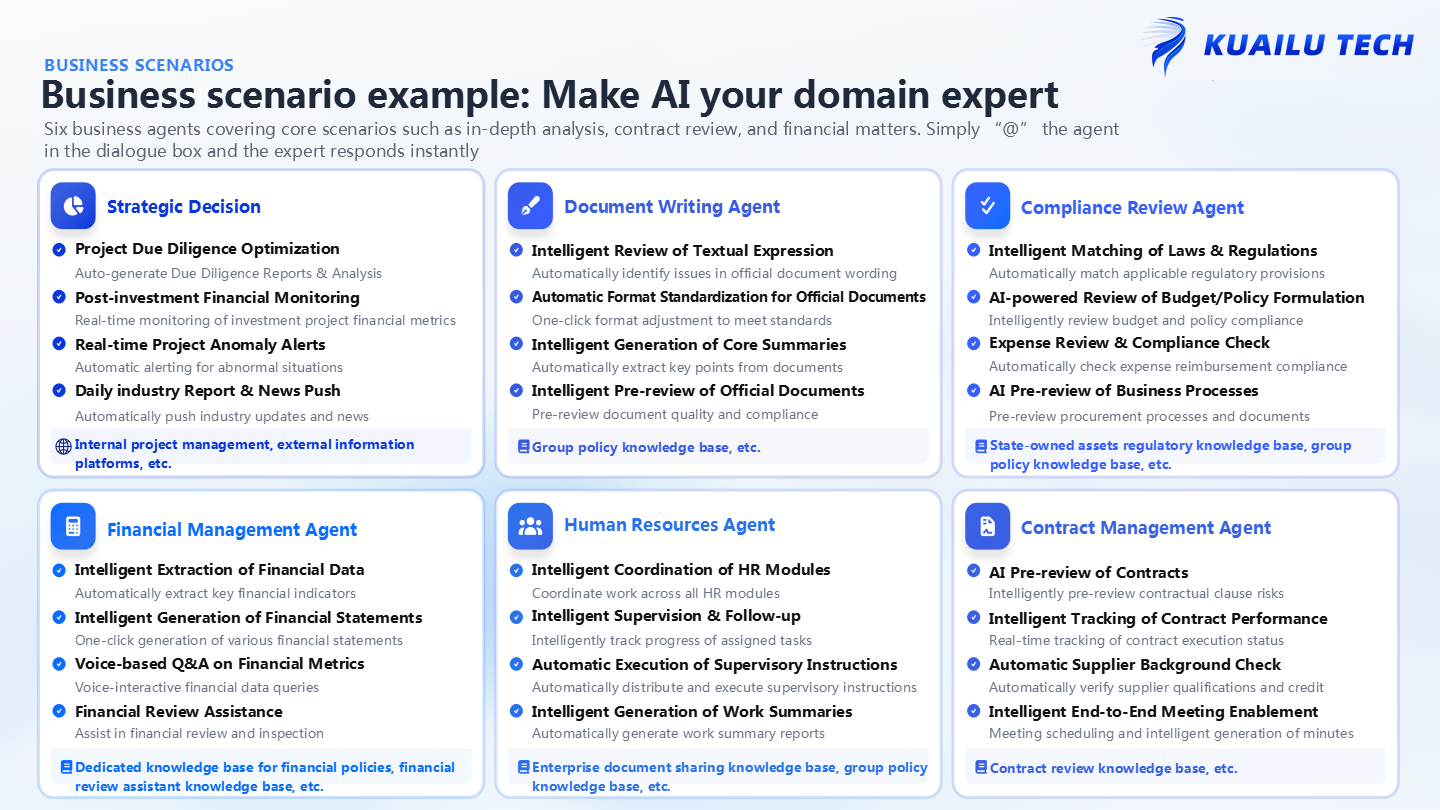
The Kuailu AI Domain Expert has developed a matrix of six specialized capabilities covering core business scenarios. Each module can be deployed independently or operate collaboratively.
1.Deep Analysis Expert: Built on the LangGraph-deepresearch framework. Supports integrated collection of publicly available data and internal enterprise data, employing iterative search and cross-validation to automatically generate in-depth research reports. Compresses the traditional analyst's 3-day report generation cycle to 3 hours.
2.Document Writing Expert: Leverages a "document standards library" and a "historical document corpus." Provides intelligent review of textual expression, automatic formatting of documents to meet standards, intelligent extraction of core elements, and intelligent pre-review of document quality. Significantly reduces document rejection rates and formatting time.
3.Compliance Review Expert: Integrates real-time access to legal and regulatory databases alongside internal control guidelines. Supports intelligent matching of regulatory provisions, AI-based pre-review of procurement and contract processes, and compliance review of budget and system preparation. Effectively reduces enterprise operational risk.
4.Financial Management Expert: Deeply connects ERP and financial systems via NL2SQL. Supports natural language querying of financial data, automated multi-dimensional report generation, core metric trend analysis, and automatic anomaly alerts. Business users can obtain second-level responses to complex financial inquiries without SQL expertise.
5.Human Resources Expert: Orchestrates intelligent coordination across recruitment, attendance, performance, and training modules. Supports automatic generation of work summaries, automatic distribution and tracking of supervisory tasks. Frees HR resources to focus on high-value strategic work.
6.Contract Management Expert: Connects OA and contract management systems. Enables AI-based contract clause pre-review, automatic risk clause identification, intelligent contract performance tracking, and proactive reminders for critical milestones. Shifts compliance review from reactive remediation to proactive prevention.
V. Industry Trends: From System Integration to Intelligent Orchestration
Reviewing the past two decades of enterprise information technology development, large enterprises have generally progressed from building single systems to integrating multiple systems, and from process digitization to data assetization. However, as the number of systems has grown, the cost of cross-system coordination has also continuously increased.
In the next decade, the core proposition of enterprise AI digitization will undergo a fundamental shift in technology stack: moving beyond simply "deploying more systems" to "building a unified intelligent orchestration layer on top of existing systems." The core value of this layer lies in:
Preserving Existing Investments: No replacement of existing systems, ensuring that the tens of millions already invested in information technology assets continue to deliver value.
Reducing Transformation Costs: The non-invasive connection approach compresses the multi-million-dollar investments and annual timelines of traditional system upgrades into hour-level deployment.
Respecting Organizational Habits: Employees leverage AI capabilities within their existing work interfaces, incurring zero learning costs and avoiding short-term disruptions to organizational efficiency.
The design of the Kuailu AI Domain Expert represents a strategic response to this industry trend.
The information technology assets of large enterprises represent the valuable outcomes of years of investment. The goal of AI-driven digital intelligence transformation is not to start over, but to orchestrate and coordinate these mature systems intelligently.
Kuailu AI Domain Expert connects heterogeneous systems through a non-invasive approach, enabling cross-system data retrieval and business execution within the conversation interface. It provides employees with a digital colleague who "understands the business, connects the systems, and operates within the rules," all within their familiar work environment.
No System Replacement, No Process Modification, No Retraining.
— This is Kuailu's solution to the AI transformation challenges faced by large enterprises, and a practical response to the industry proposition that "the more mature the systems, the harder the transformation."