



How to Choose an ERP System for Manufacturing Enterprises? KuaILu Cloud Smart Office System Reduces Inventory Error Rate to 0.001%
As a manager in a manufacturing enterprise, do you often encounter the following scenarios:
- Inventory Mismatches: Warehouse stocktaking is time-consuming and labor-intensive, with data never aligning, leading to frequent overstock and stockout issues.
- Gut-feel Purchasing: Multiple warehouse data systems are disconnected, lacking low-stock alerts, forcing reliance on experience for ordering.
- Chaotic Production Planning: Inefficient production scheduling often results in overproduction or underproduction.
- Slow Approval Processes: Paperwork is everywhere, and a single purchase approval can take days.
- Fragmented and Messy Data: Sales, warehousing, and finance operate in silos, lacking an integrated, holistic perspective.
Data shows that under traditional management models, inventory overstock in manufacturing enterprises can account for up to 12% of total sales, while the proportion of stagnant procurement may be as high as 15%–30%. Behind these figures lies the continuous erosion of corporate profits.
 I. The Digital Transformation Dilemma: It’s Not a Lack of Will, but a Lack of Means
Most manufacturing companies are well aware of the importance of digitalization, yet they find themselves stuck in a dilemma during implementation:
- Growing Enterprises (10–200 employees): Lack a dedicated IT team and have limited understanding of IT products. Excel-based management is inefficient, while standardized systems are expensive and inflexible. Frequent organizational changes during rapid business expansion make existing systems difficult to adapt to dynamic needs.
- Medium and Large Enterprises (500+ employees): Have deployed multiple independent systems, resulting in severe data silos. Departments have fragmented, long-tail needs that are hard to meet with off-the-shelf products. Custom development is time-consuming and costly, with significant challenges in secondary development for changing requirements.
II. KuaILu Cloud’s “AI + Low-Code” Solution: Redefining a New Ecosystem for Manufacturing Management
Addressing the industry’s challenges of inflexible “all-in-one” systems and high-cost custom solutions, KuaILu Cloud leverages an “AI + Low-Code” core to build a flexible, easy-to-use, and cost-effective intelligent solution—like “digital building blocks”—precisely tackling the pain points in manufacturing management.
1. Low-Code: Simplifying Digital Implementation
Zero-Barrier Rapid Development: Business personnel can design forms and configure workflows in just 5 minutes through visual drag-and-drop. End-to-end digitalization from procurement and inventory to financial accounting can go live within weeks.
Flexible Adaptation to Dynamic Needs: Modules can be added or removed as required, and functionalities adjusted alongside business changes. Organizational and process adjustments during growth require no secondary development or repurchasing.
Significant Cost Reduction and Efficiency Gains: Compared to traditional custom development, R&D costs are reduced by 60%–70%, with an investment of around 100,000 yuan covering core scenarios. Implementation cycles are shortened by 80%, delivering rapid results.
2. AI Intelligence: Driving Scientific Decision-Making
AI capabilities elevate management from “human-driven” to “intelligence-driven”:
- Intelligent Queries: Managers can directly ask questions like “total procurement last month” or “OEE of the production line,” and the system retrieves and answers with real-time data, eliminating manual data compilation.
- Intelligent Search: Employees can query policies or manuals, with AI providing instant replies, significantly improving knowledge access efficiency.
- Voice Approval: Approval comments can be input via voice, automatically converted to text with intent recognition, boosting approval efficiency by over 80%.
III. Phased Implementation Path: Steady Digital Transformation
- Basic Digitization (10–50 employees): Focus on inventory, sales, and asset management to achieve data visualization and break down information silos.
- Process Standardization (50–200 employees): Extend to CRM, contracts, and HR management, enabling standardized end-to-end operations.
- Comprehensive Intelligence (200+ employees): Deploy administrative and customized systems, integrating AI for full-scenario collaboration and building a smart manufacturing system.
IV. Comprehensive Coverage of Core Scenarios
The solution deeply addresses key management areas in manufacturing:
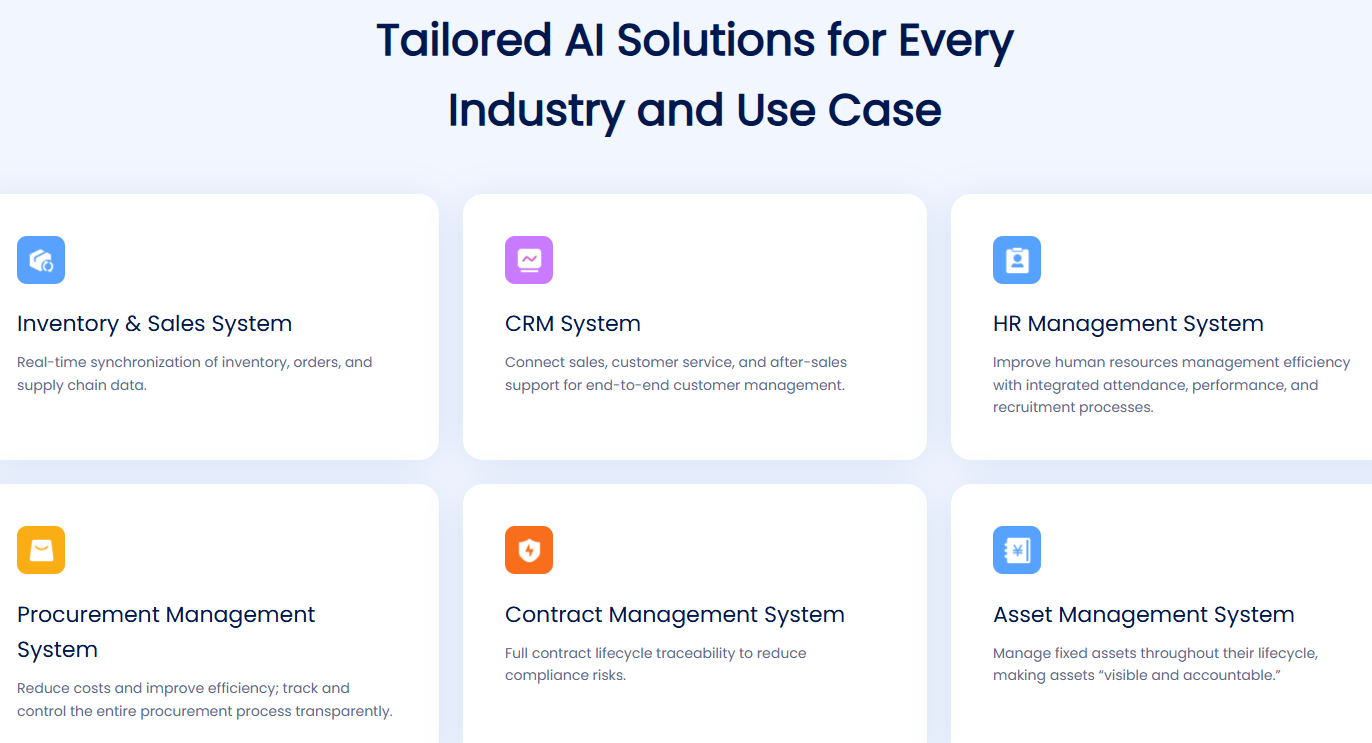
Inventory, Sales, and Procurement Management: Closed-loop, end-to-end processes with real-time dashboards and standardized workflows to reduce the risk of stagnation and overstock.
Asset and Contract Management: Full lifecycle asset tracking via scanning, integrated management of contracts, payments, and more.
CRM and Human Resources: Unified lead management, end-to-end online employee processes, and visualized data to support decision-making.
Financial Applications: Automatic synchronization of operational and financial data, reducing reconciliation error rates to below 0.001%.
Competition in the manufacturing industry is intensifying, and digitalization has become the key to breaking through. With a technical team comprising over 50% of its R&D staff, 19 software copyrights, and 7 invention patents, KuaILu Cloud has helped companies like Hong Kong Tongwei Textile and Dongguan Hecheng achieve an 80%–90% acceleration in approval processes, reduced inventory error rates to 0.001%, and significant sales growth.
Starting with core pain points and rapidly deploying iterative solutions is the optimal path to digitalization for manufacturing enterprises.