



Kuailu Cloud:The AI-Powered Office Revolution Business Leaders Must See
Gartner predicts that by 2026, over 80% of enterprises will use generative AI APIs or models, rendering legacy systems the most significant "technical debt" in this transition. For business leaders, this is no longer a question of optional upgrades but a strategic imperative for organizational survival.
The Generational Divide: Sitting on a Digital Time Bomb
The core conflict facing modern enterprises is the fundamental mismatch between exponentially growing business complexity and linearly evolving legacy systems.
Outdated CRM and OA systems were largely born in the era of process standardization. They function essentially as "digital filing cabinets," adept at recording rather than thinking, and designed for rigidity over agility.
McKinsey research highlights the severity of the problem: knowledge workers spend nearly one and a half days each week searching for information, coordinating communications, and performing manual tasks—precisely the pain points legacy systems fail to solve.
Data silos act as a "congenital cataract" for corporate decision-making. Sales data is locked in an on-premise CRM, customer service records reside in another system, and financial approvals are stuck in an OA workflow. An IDC study found that data fragmentation causes an average 67% delay for decision-makers trying to obtain a unified business view.
A senior executive from a manufacturing firm in Eastern China described a quarterly ritual: three specialists spending a week manually extracting and reconciling data from 17 independent systems before each business review meeting. "We weren't analyzing our business; we were performing data archaeology."
The cost structure is also inverted. A Forrester report indicates that maintaining a legacy system over seven years old can incur annual hidden costs (including integration, manual workarounds, and opportunity loss) amounting to 3-5 times the software's initial purchase price. These systems function like "digital fossils," continuously draining organizational vitality while providing no evolutionary value.
The AI-Enabled System: From “Humans Adapting to Tools” to “Tools Adapting to Humans”
Kuailu Cloud — The fundamental difference between this new-generation AI-powered intelligent office system and traditional systems lies in its achievement of a paradigm shift in how humans interact with tools.
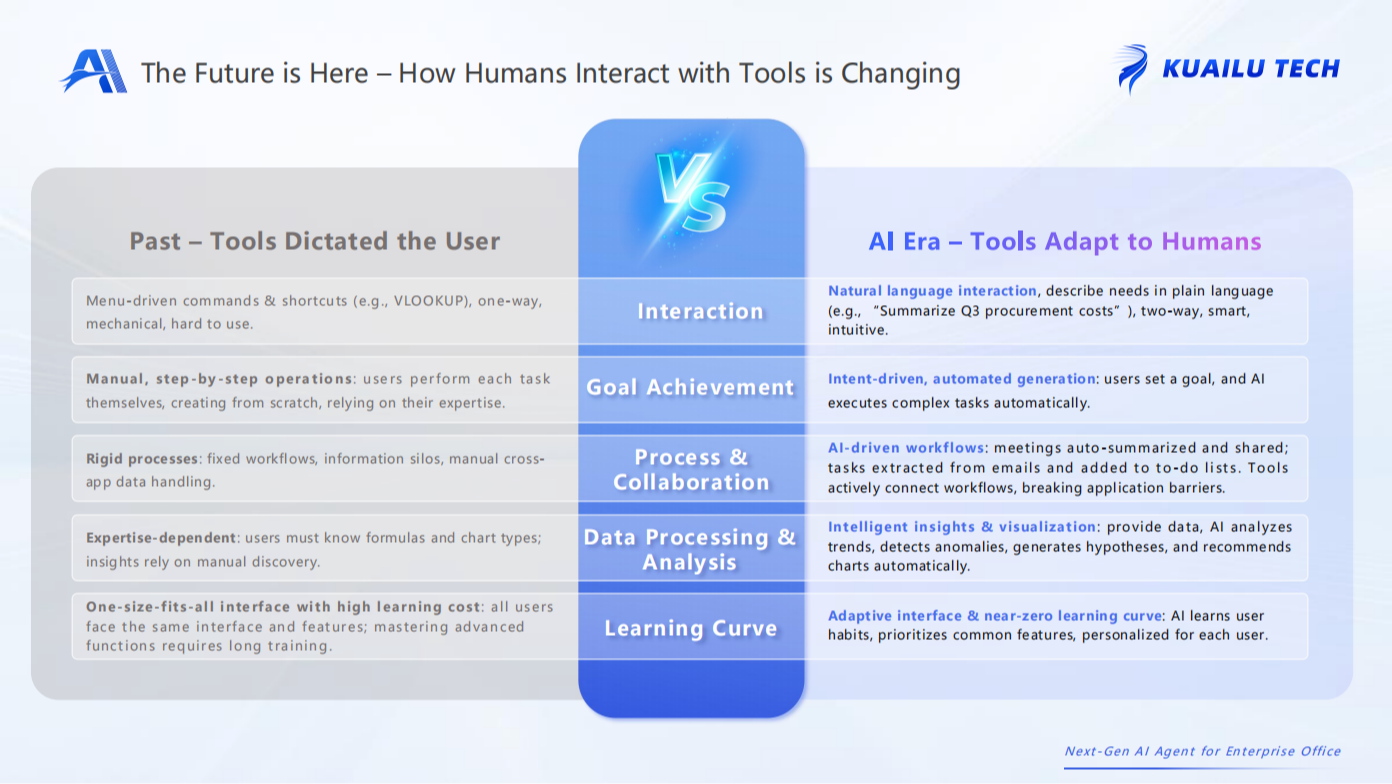
1. From "Process-Driven" to "Intelligence-Driven"
Legacy systems force employees to adapt to fixed workflows. AI systems allow workflows to adapt to business contexts.
Consider customer follow-up: in a traditional CRM, a sales representative must manually log interactions, set reminders, and search for product information. while AI In empowered systems, such as the case demonstrated by the Kuailu Cloud platform, AI Capable of automatically analyzing and identifying key customer needs through natural language, intelligently searching and capturing product related information
The direct result is that sales teams can increase the proportion of time spent on core activities from less than 35% to over 60%.
2. From "Human-Finds-Information" to "Information-Fits-Human"
Gartner states that by 2025, over 50% of knowledge workers will rely on AI assistants to surface critical information by default, rather than actively searching for it.
AI office systems comprehend an employee's role, task context, and business objectives to proactively deliver relevant insights. A marketing director opening the system doesn't see a to-do list but rather "analysis of competitor's latest moves," "effectiveness forecast for this month's campaigns," and "three growth opportunities requiring your attention."
This "cognitive collaboration" shifts decision-making from "rear-view mirror observation" to "windshield navigation."
3. From "Data Storage" to "Insight Generation"
Legacy systems accumulate data; intelligent systems create insight.
In the AI office solution implemented by Kuailu Cloud for a retail enterprise, the system enables precise product management through a Unified Product Information Library, providing a centralized repository to ensure product consistency and accuracy. It tracks the product life cycle from introduction, growth, maturity to decline stages, resulting in a 40% increase in marketing campaign response rates.
This embodies the IDC-predicted automation of "data-to-insight"—by 2027, 30% of corporate decisions globally will be directly driven by AI-augmented insights.
Strategic Level: Building the Organizational "Digital Twin"
The ultimate value of an AI office system lies in creating an enterprise's "digital twin"—a virtual model that can reflect, simulate, and predict organizational operations in real-time.
Boston Consulting Group research shows that enterprises with mature "digital twin" capabilities can shorten new product time-to-market by 25% and reduce operational costs by 20%.
Such a system no longer just records what happened but can answer strategic "what-if" questions: What is the profit impact across product lines if raw material prices rise 15%? How would logistics costs and delivery times change if a new distribution center were added in the Southwest?
Operational Level: Achieving "Frictionless Collaboration"
While legacy systems often deepen departmental barriers, AI systems promote cross-functional integration.
McKinsey analysis indicates that AI-enabled collaboration tools can reduce cross-department coordination time by approximately 30% and accelerate project delivery by 20-30%.
An intelligent office platform built by Kuailu Cloud for a manufacturer integrated sales, production, supply chain, and after-sales service data into a unified workspace, reducing order status tracking from an average 4-hour manual query to real-time visibility.
Talent Level: Liberating Higher-Order Cognitive Abilities
The most significant "humanistic value" of AI office systems is freeing up uniquely human capabilities: creativity, empathy, and complex judgment.
The World Economic Forum forecasts that by 2027, AI technologies will save an average of about 2.5 hours per employee per week through task automation. More importantly, it transforms the nature of work: customer service representatives no longer need to memorize all product details but can focus on understanding customer sentiment and providing personalized solutions; financial analysts are freed from data compilation to delve into the business logic behind trends.
The Transformation Path: From "Digital Fossil" to "Enterprise office AI agents"
How should enterprises initiate this inevitable transformation? Three core principles are crucial:
1. Value-Led, Not Technology-Driven
Accenture research finds that 78% of successful enterprises in AI transformation first define business goals and value expectations, not technical specifications.
Leaders should ask not "What AI features do we need?" but "What business pain points are we solving?": Is it reducing customer response time by 60%? Increasing sales forecast accuracy by 40%? Or mitigating compliance risks by 35%?
2. Progressive Integration, Not Radical Replacement
Deloitte research shows that enterprises adopting a "progressive integration" strategy have a digital transformation success rate 2.3 times higher than those opting for "radical replacement."
Start with the most painful, highest-value scenarios: intelligent contract analysis, automated customer segmentation, meeting decision tracking, etc. An AI office solution implemented by Kuailu Cloud for a law firm began with the single point of "intelligent contract review," improving contract scrutiny efficiency by 70% within three months, laying the groundwork for comprehensive transformation.
3. Ecosystem Thinking, Not Isolated Systems
Modern AI office systems should be open capability platforms, not closed software suites.
Forrester emphasizes that post-2025, the core metric for evaluating office systems will be "ecosystem connectivity"—the seamless integration with other tools, data, and services inside and outside the enterprise. Decision-makers should choose solutions that organically integrate with existing critical systems while allowing room for future expansion.
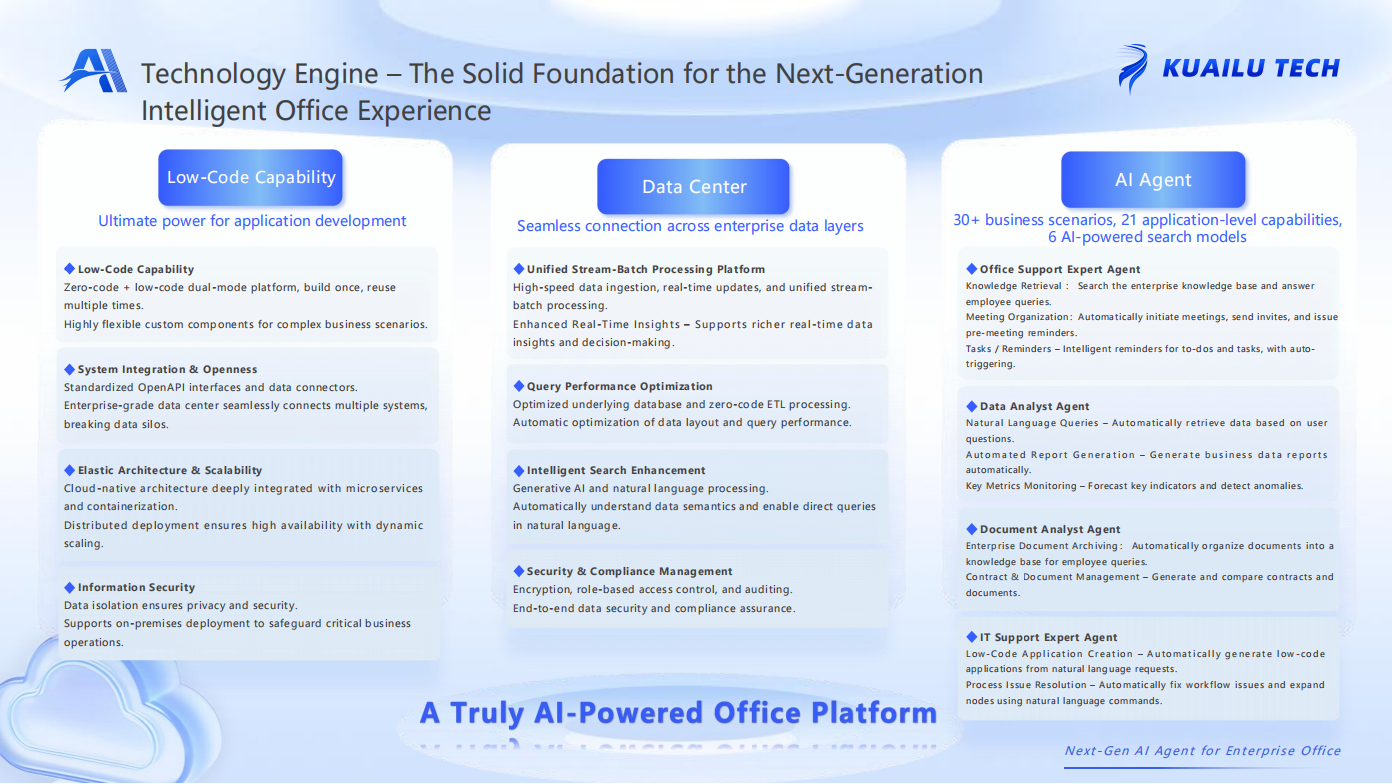
Kuailu Cloud empowers enterprises with a one-stop AI-powered intelligent office system through AI + low-code technology. The low-code platform not only adapts to current business needs but also allows for real-time adjustments to workflows as the enterprise evolves, enabling rapid development of CRM, finance, and other applications. It supports various deployment options, including public cloud, private cloud, hybrid cloud, and on-premises deployment.
The Moment of Decision: The Window is Closing
Research from Stanford University's Digital Economy Lab tracking early AI adopters in the workplace shows their productivity growth rates are, on average, 4-6 percentage points higher than late adopters, with the gap widening over time.
This disparity is not merely about efficiency but about cognition. When one enterprise's system can predict customer needs, simulate decision outcomes, and automate knowledge transfer, it competes on a different dimension than a peer reliant on manual experience, procedures, and post-hoc analysis.
Enterprises clinging to "digital fossils" risk not just technological obsolescence but organizational cognitive downgrading. While a competitor's AI system is learning, evolving, and predicting, your team remains stuck retrieving, compiling, and reporting.
This is no longer a debate about whether to upgrade systems but a question of whether an enterprise can maintain cognitive competitiveness in the intelligent age. Legacy systems record the past, while AI-enabled systems are creating the future. The watershed moment for that future is in the decisions made now.
While your team copies and pastes data between systems, intelligent enterprises are using that same data to train models predicting the next growth opportunity. Time does not side with those who wait; it only accelerates the advantage of those who move forward.
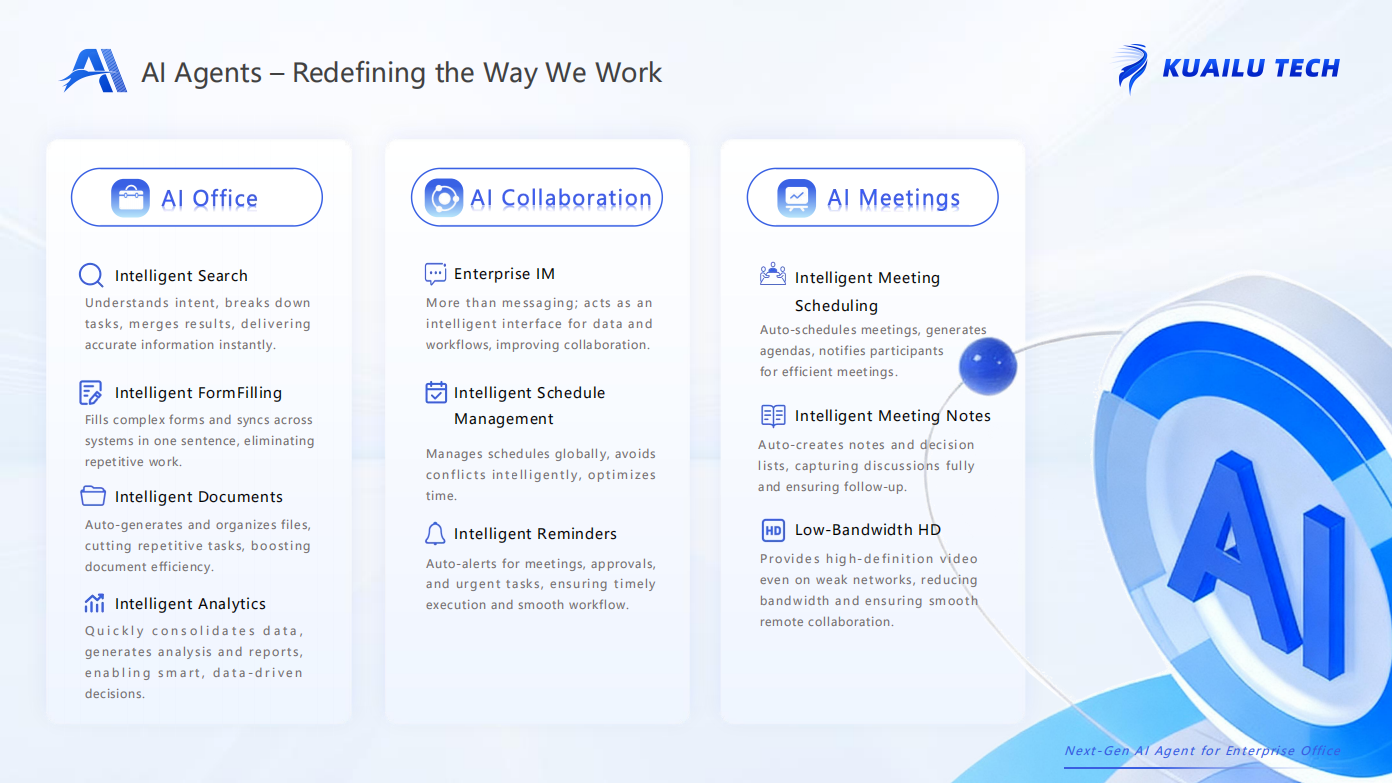
Kuailu Technology provides enterprises with a new - generation AI - powered intelligent office system. It is a management tool that helps enterprises make smart, rapid, and efficient decisions. This system offers a range of functions, including AI - powered intelligent search, AI - powered intelligent form - filling, AI - powered intelligent document management, AI - powered intelligent digital analysis, AI - powered intelligent IM (Instant Messaging), AI - powered intelligent schedule management, AI - powered intelligent reminder function, AI - powered intelligent meeting organization, AI - powered intelligent meeting minutes generation, and narrow - band high - definition meeting functionality.With underlying data integration and interoperability, it leverages the synergistic effects of multiple functions to enhance enterprise office efficiency and build a customized intelligent office system for enterprises. It also ensures that enterprise data is secure, traceable, and cannot be deleted.