



The way enterprises work is being rewritten by AI
In the spring of 2026, the buzz in China's tech scene didn't belong to any hardware product—it belonged to a "lobster."
Outside Tencent's headquarters in Shenzhen, nearly a thousand people lined up, laptops in hand, waiting for a free installation of OpenClaw—an open-source AI agent iconified by a red lobster. The crowd included office workers on lunch breaks, retirees queuing for their children, On-site engineers described the scene as "comparable to the New Year's red envelope rush."
The core logic behind this frenzy boils down to four words: from "telling" to "doing."
No matter how intelligent previous AI models were, they remained in the role of advisors—telling you what to do. But OpenClaw, as an AI agent, can directly operate computers, write code, reply to emails, monitor trends, and even execute quantitative trades. Fu Sheng, founder of Cheetah Mobile, managed his company from a hospital bed using a single "lobster"—updating his public account daily, sending personalized New Year greetings to 611 employees, and generating millions of views on short videos. This is no longer a tool; it's an "employee."
As the nation debates "farming lobsters," one question surfaces: For real businesses, do they need the "open-source toys" that geeks tinker with, or do they need "professional employees" that seamlessly integrate into organizational processes and remain secure and controllable?
This is precisely the answer that Kuailu Intelligent Office provides.
I. A Shared Core Philosophy: From "Tools Dictated the User" to "Tools Adapt to Humans"
OpenClaw's explosion is no accident. It accurately taps into the deep-seated desire of every post-pandemic professional: Let tools do the work; let humans do the thinking.
In a viral article titled Services: The New Software, Sequoia Capital argued that the next trillion-dollar company will be a "software company disguised as a service company"—one that doesn't sell you tools to do the work yourself but directly completes the work for you. OpenClaw's disruptive power lies here: users don't want a chatty dialog box; they want the result—"someone else did the work for me."
This aligns perfectly with the core philosophy that Kuailu Intelligent Office has held since its inception.
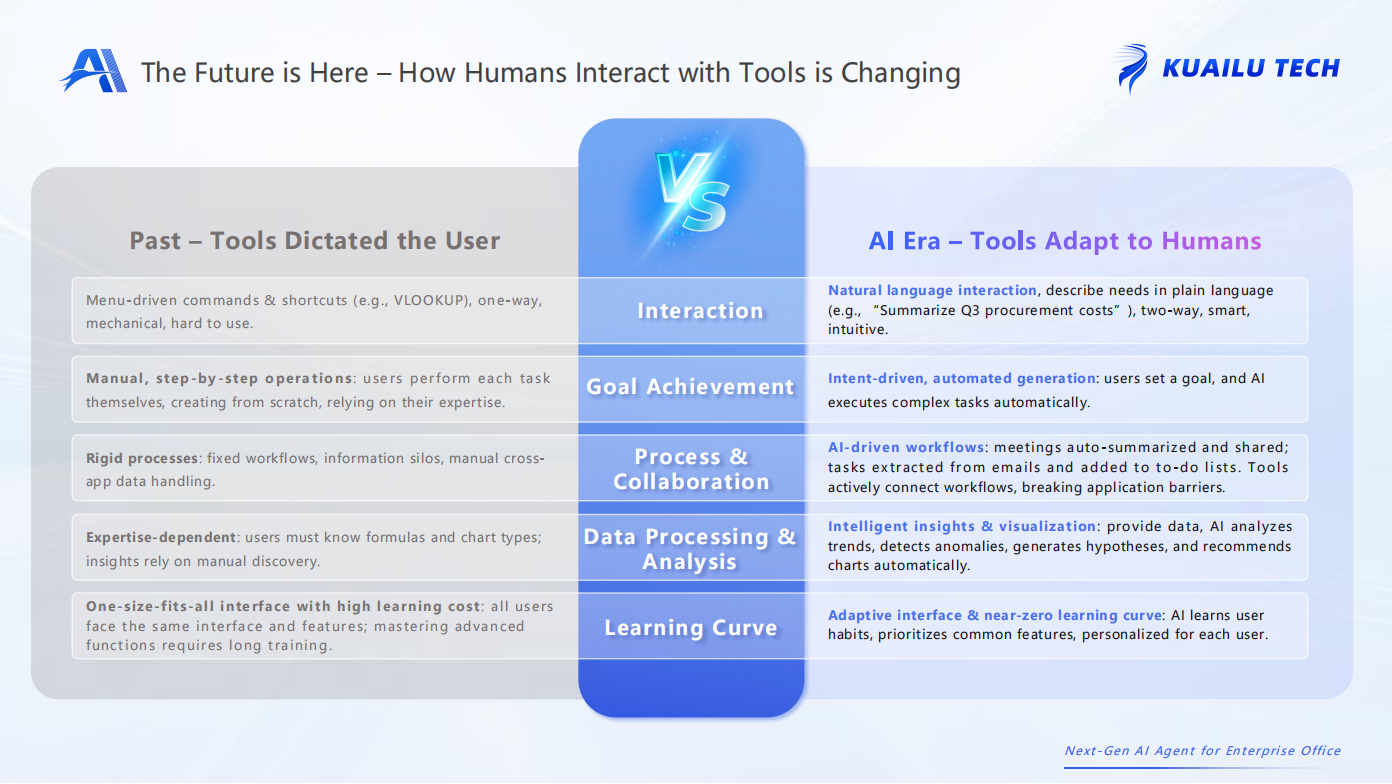
Back at its launch event in September 2025, Kuailu Intelligent Office clearly stated: The paradigm shift in the office domain is fundamentally about moving from "humans adapting to tools" to "tools adapting to humans." Tools should not be cold machines; they should become office partners that "understand needs and respond accordingly." This philosophy stems from Kuailu Intelligent Office's own pain point—in their early days, preparing a single client report required switching back and forth between CRM, ERP, OA, and other systems, taking nearly a full day. This fragmented experience made them deeply realize: if tools cannot adapt to human needs, digitalization becomes an obstacle to efficiency.
Now, the "lobster farming" craze sweeping the nation validates Kuailu Intelligent Office's foresight. While ordinary people hesitate over a "500-yuan installation fee," and geeks tear their hair out over a mistyped character in a command line, Kuailu Intelligent Office has already turned the concept of "Tools as a Service" into a mature product matrix.
II. From "Farming Lobsters" to "Hiring Employees": Kuailu Intelligent Office's Six Application Scenarios
If OpenClaw gave ordinary people their first taste of "having someone do the work for me," Kuailu Intelligent Office aims to give enterprises a true "on-demand digital workforce."
In Kuailu Intelligent Office's product philosophy, an AI agent is not complex software that users must learn; it's an "intelligent colleague" that can listen, understand, and execute. This philosophy has been translated into specific solutions covering high-frequency enterprise scenarios:
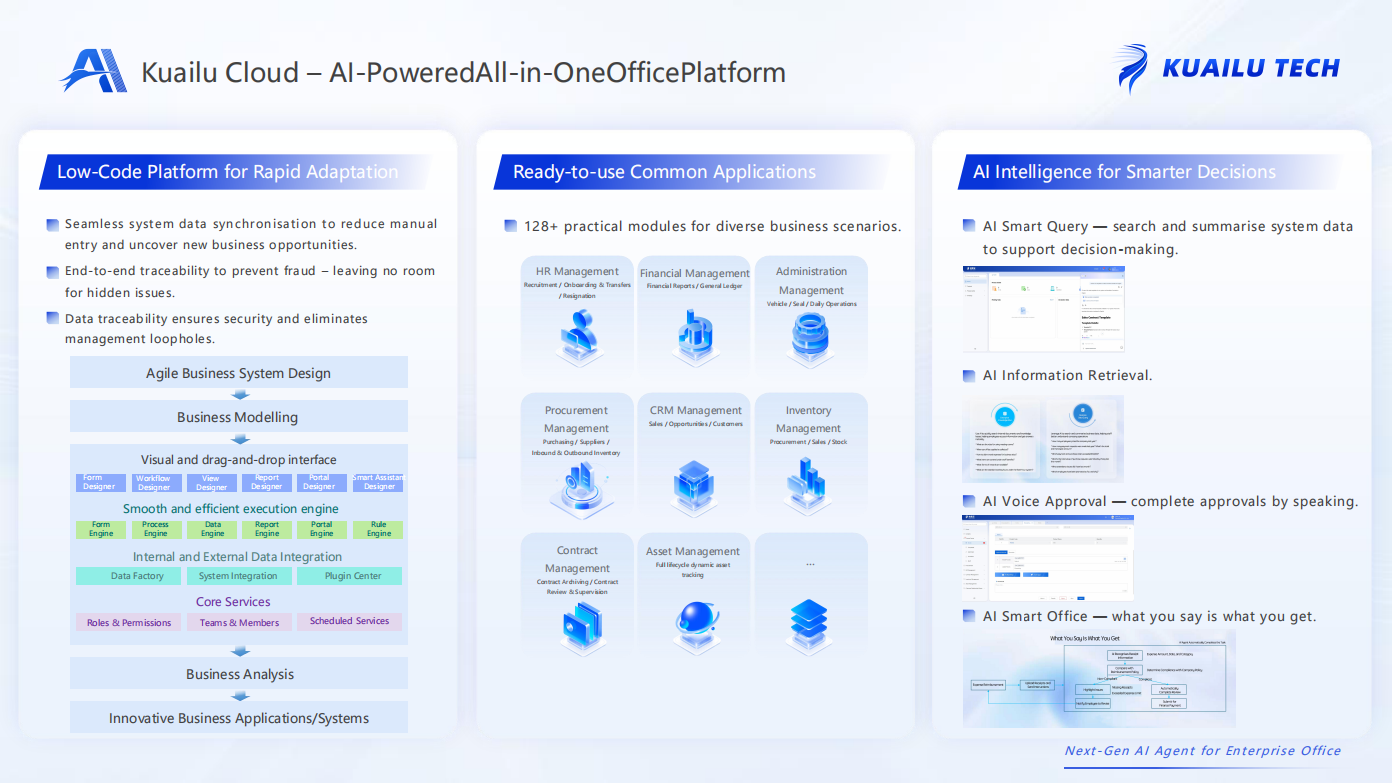
In sales, the AI optimizes visit routes, gains customer insights, and generates contracts instantly—compressing hours of work into minutes. This is true "sales acceleration."
In procurement, when the system triggers a material alert, procurement staff don't need to manually check inventory sheets. With a single voice command, the AI automatically compares supplier prices, filters delivery cycles, and generates a clear comparison table.
In administrative approvals, managers no longer face endless waiting. Kuailu Intelligent Office's "voice-based approval" feature isn't simple speech-to-text. When a manager says, "The procurement department must conduct quality inspection and approval, handle it immediately," the system uses semantic recognition to accurately parse the core intent—"approve + quality inspection requirement + urgent execution"—automatically pulls data from finance, procurement, and project systems to form a decision reference, and notifies relevant personnel after approval. This enables a full-chain intelligent interaction of "command-analysis-decision-synchronization."
One manager at a large enterprise once faced the extreme pressure of processing up to 200 approvals in a single day. Assuming a 10-hour workday, each approval had just three minutes of available time. With Kuailu Intelligent Office's help, this manager transformed from an "information collector" back into a "business decision-maker."
HR recruitment, financial analysis, team collaboration… Kuailu Intelligent Office's coverage of six key scenarios essentially answers one question: When AI can do the work, how should companies redefine everyone's role?
III. Value Upgrade: From "Selling Tools" to "Selling Results"
A fascinating phenomenon in the OpenClaw craze: the first people to make money from it were the freelancers offering "doorstep installation services." This highlights an awkward reality—truly valuable technology often remains out of reach for ordinary people due to barriers.
But as the article 2026: Tool Sellers Will Die, Doers Take the Throne stated: The shift from SaaS to RaaS (Results as a Service) is fundamentally about moving from selling subscriptions to selling results. Those making quick money from installations will soon find that once tech giants (like Xiaomi, Tencent, Alibaba) integrate agents into their underlying platforms, this business will quickly vanish.
Kuailu Intelligent Office chose the "selling results" path from the very beginning.
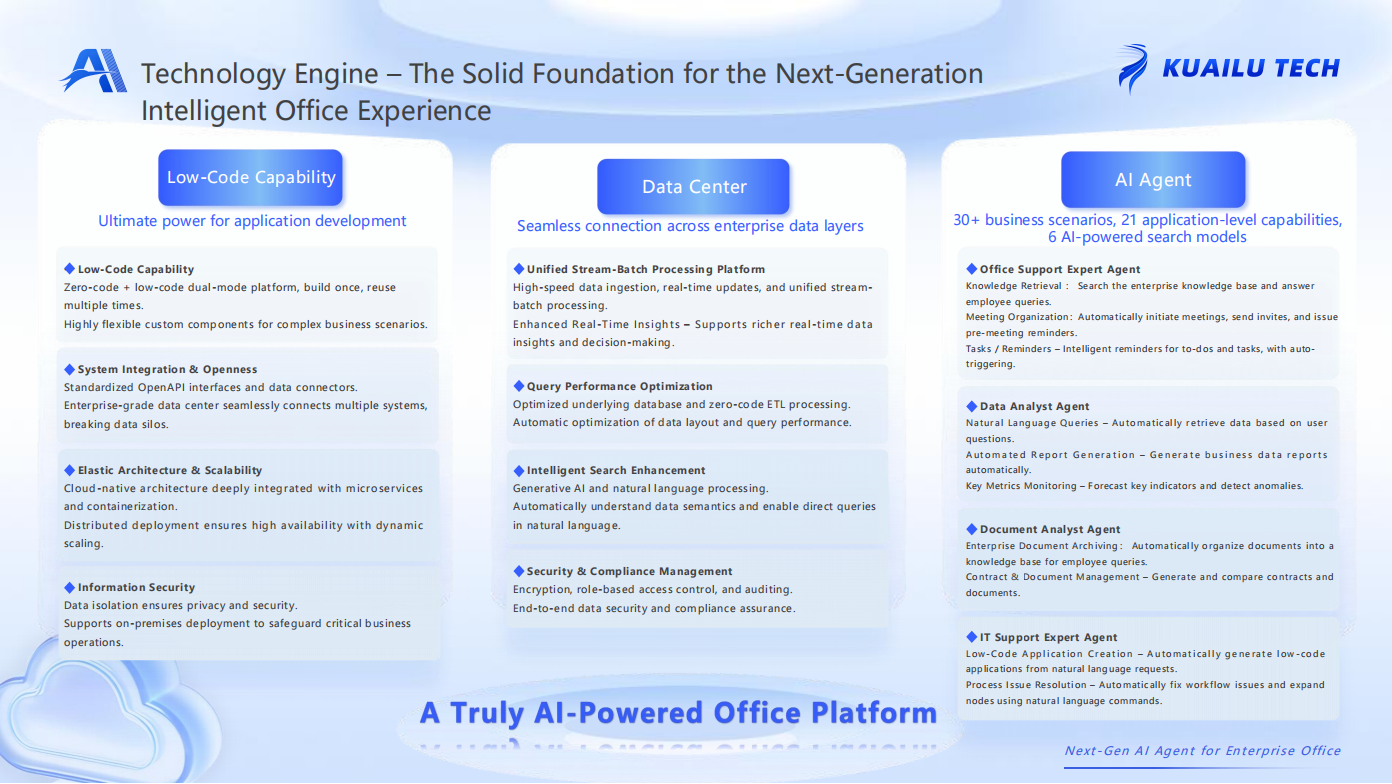
In financial analysis, Kuailu Intelligent Office aggregates data from multiple systems to provide clear, intuitive business insights, transforming finance staff from "report makers" into "strategic advisors."
In team collaboration, the AI meeting assistant enables "one-click meeting setup" and automatically generates minutes, turning meetings into creative engines that harness collective intelligence.
More importantly, Kuailu Intelligent Office has built a three-pronged security system: autonomous deployment control, closed-loop management processes, and robust technical protection. While OpenClaw users still shudder at horror stories of "AI running amok and deleting hundreds of work emails," and security experts warn that "using OpenClaw without protection is equivalent to letting your data run naked on the internet," Kuailu Intelligent Office's private deployment options and full-chain encryption technology safeguard the bottom line of an enterprise's digital home.
IV. "Digital Twin": The Ultimate Form of Intelligent Office
At its 2025 launch event, Kuailu Intelligent Office introduced an imaginative concept: the "Digital Twin."
This isn't science fiction. A sales digital twin can proactively engage with clients and warm up partnerships; a procurement digital twin can automatically plan supply solutions based on order forecasts; an R&D digital twin can participate in brainstorming sessions and propose alternative ideas. Kuailu Intelligent Office's vision is: to enable enterprises to become "intelligent organizations that can think autonomously, collaborate efficiently, and create continuously."
This aligns remarkably with the practices of "veteran lobster farmers" in the OpenClaw wave. Zhu Lianxing, a serial entrepreneur born in the 1970s, has cultivated four "twins"—one in Singapore handling quantitative trading, one in Tokyo managing website content, and one in Seoul responsible for strategy generation. He doesn't call them interns; he calls them "digital twins" : "Whatever I want to do, I let them handle it."
Han1, a 28-year-old product designer at Microsoft, has raised five "lobsters": a general manager handling schedules, an assistant monitoring investments and orders on Discord, an English teacher assigning daily lessons, and a fitness coach reminding him to exercise on time. "It's actually like managing a team," Han1 says. "They execute, give me the results, and I decide if the direction is right."
This is the future Kuailu Intelligent Office envisions: AI is no longer an auxiliary tool but an integral part of the organization.
V. When "Farming Lobsters" Becomes a Footnote of Our Time, What is Kuailu Intelligent Office Defining?
Looking back from the vantage point of 2026, the frenzy over doorstep OpenClaw installations is just the beginning—a transitional product of the shift between eras. As one columnist put it: "In the future, no one will discuss 'how to install an AI agent.' They'll just be there, serving you, making your life better."
For enterprises, the real question has never been "whether to farm lobsters," but rather: When AI can do the work, how should I restructure my organization? How should I optimize my processes? How should I protect my data?
Kuailu Intelligent Office's answer is not to have every employee tinker with command lines and fine-tune open-source models. Instead, it is to provide an out-of-the-box "AI employee team" —one that understands your business, guards your secrets, and handles those repetitive, tedious tasks, allowing you and your talent to focus on what truly creates value.
As Kuailu Intelligent Office stated at its launch: "The ultimate form of AI office work is for tools to evolve further—from 'adapting to humans' to 'serving humans.'"
This is the true revelation left by the "lobster farming" craze.