



Kuailu Intelligent Office – Kuailu Cloud: Case Study in the Renewable Resources Industry
The power battery in the car you drive might not come from newly mined minerals, but rather from "urban mines" recycled from end-of-life electric vehicles. The plastic casing of the phone in your hand could very well be a discarded beverage bottle from just a month ago, reborn through circular reprocessing.
Driven by global resource constraints and the "Dual Carbon" strategy, the renewable resources industry is transforming from an unassuming "junk collecting" business into a strategic emerging industry, crucial to national resource security and boasting a market size exceeding one trillion yuan.
As a witness to industrial digital upgrading, Kuailu Intelligent Office, leveraging the transformation experience of leading companies like China Renewable Resources (China Recycling), is launching a series of observations on the renewable resources industry. This series aims to clarify the industry's development context and discern future transformation trends for enterprises.
From "Junk Collecting" to a "Trillion-Yuan Track": The Industry Is Taking Off
China's renewable resource recovery includes 11 main categories: scrap iron and steel, non-ferrous metals, waste plastics/paper, waste electrical and electronic equipment, waste batteries (excluding lead-acid batteries), decommissioned wind power and photovoltaic equipment. The latest data shows the total recovery value for these 11 main categories is approximately 1.34 trillion yuan, a year-on-year increase of 2.8%.
Furthermore, with the implementation of equipment renewal initiatives, emerging industries like wind power, photovoltaics, and new energy vehicles are entering their initial decommissioning phase. Data predicts that by 2030, China will generate 1.5–2 million tons of waste photovoltaic modules, about 500,000 tons of waste wind turbine blades, and approximately 1 million tons of waste power batteries. These emerging fields, characterized by high technology content and high added value, are attracting numerous enterprises and will reshape the industry landscape.
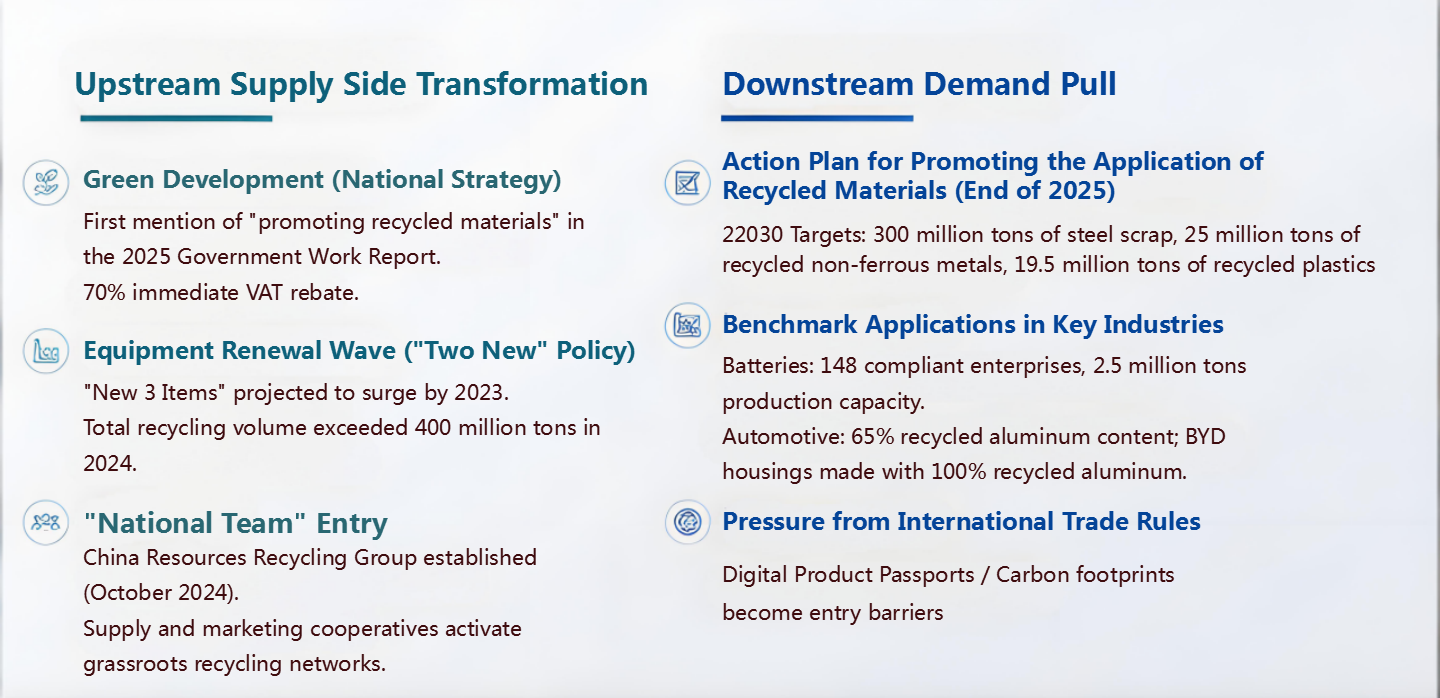
In the 2026 Government Work Report released just this year, "implementing comprehensive solid waste management actions" and "strengthening the recycling of renewable resources" were formally incorporated into the national top-level design, once again underscoring the urgency of transforming the renewable resources industry. Earlier, at the end of 2025, the "Promotion Plan for Recycled Materials" jointly issued by seven departments clearly defined the scope of use and management systems for recycled materials, strongly promoting their increased application in downstream markets such as automotive and electronic products. Currently, the usage rate of recycled aluminum in the new energy vehicle sector has reached 65%, and some power battery casings have achieved 100% recycled aluminum substitution.
With abundant upstream resources flooding in and downstream policies rigidly raising entry barriers and mandating higher proportions of recycled materials, a trillion-yuan opportunity is taking shape within this age-old industry!
Amidst the Boom, an Industry Shakeout Has Begun
Every opportunity also brings a significant shakeout among participants. With the deepening of "anti-involution" policies and the acceleration of green and low-carbon transformation, the government has repeatedly signaled the gradual elimination of outdated production capacity, guiding the industry towards standardized, high-quality development. Renewable resources are characterized by long processing chains and numerous participants. The extensive production model of the past is unsustainable under new demands. Facing this trillion-yuan opportunity, enterprises must contend with the following realities:
Challenge 1: Highly Fragmented Supply Chain, Severe Cost Volatility
Dispersed recycling channels, unstable raw material supply, and sharp fluctuations in upstream material prices make refined cost accounting crucial for core competitiveness. Taking scrap aluminum recycling as an example, price swings exceeded 30% in 2024 alone, and a minor misstep can erode profits.
Challenge 2: Dual Pressure from Technology and Environmental Compliance, Continuously Rising Costs
Traditional recycling technologies are energy-intensive and highly polluting, while new technologies involve high R&D thresholds and significant investment. Concurrently, increasingly stringent environmental regulations force enterprises to continuously invest in process optimization and environmental compliance.
Challenge 3: High Downstream Traceability Requirements, Lagging Management Capabilities
More and more downstream companies require upstream suppliers to provide full-chain traceability proof: where the raw materials came from, what processes they underwent, and whether quality standards were met. Without traceability capabilities, companies cannot even obtain the "ticket" to become a core supplier. This presents an unprecedented challenge to the internal traceability capabilities of enterprise management.
As decommissioning volumes surge and categories become more complex—especially since recycling is not a one-time transaction but requires full lifecycle management from collection to shipment—companies' existing extensive management methods lead to low production efficiency, blind spots throughout operational processes, and an inability to present performance data. The era of managing records with Excel, overseeing production with veteran experience, and making decisions based on intuition is coming to an end.
Kuailu Intelligent Office: Empowering Enterprises with Digital Technology to Seize the Trillion-Yuan Opportunity!
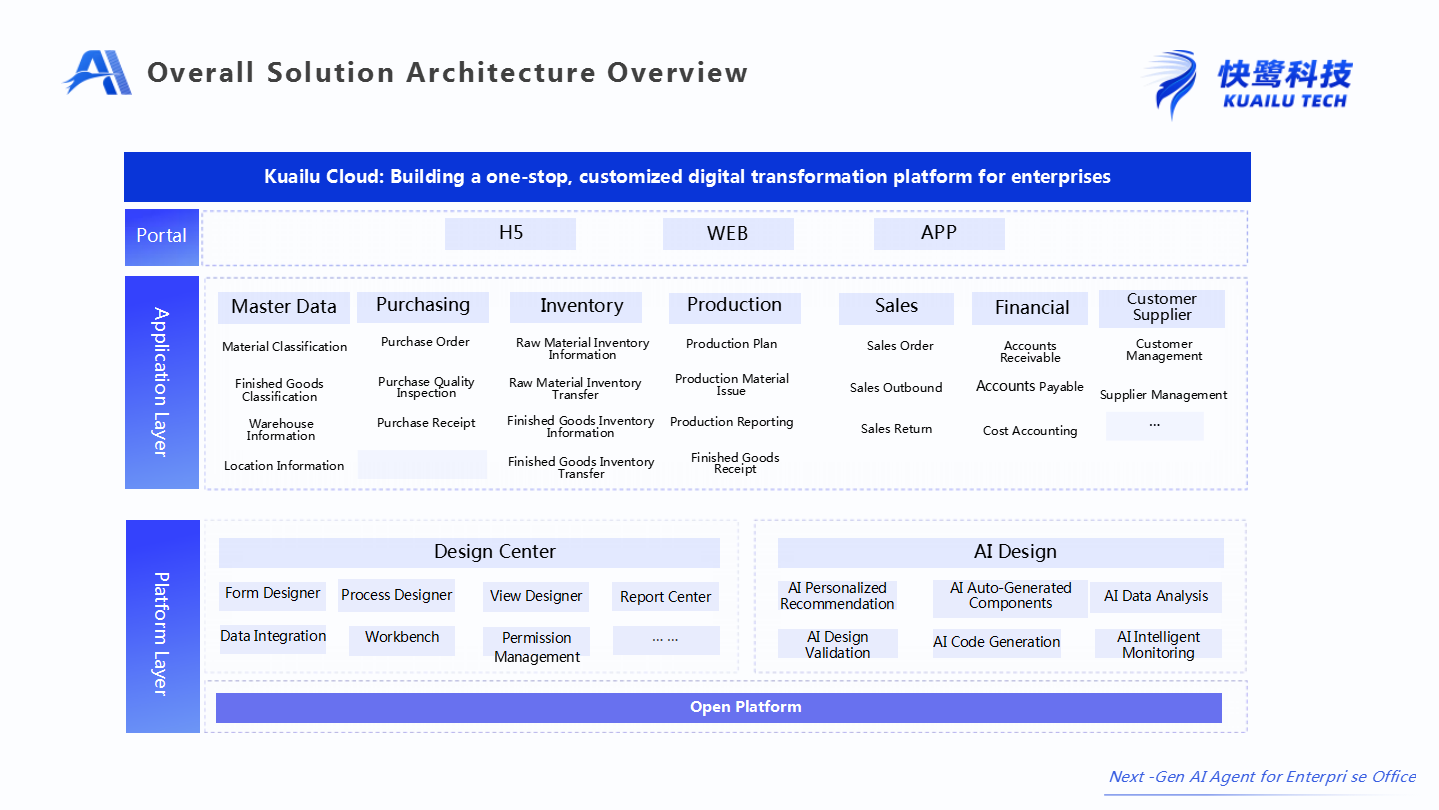
As a pioneer focused on the intelligent office sector, Kuailu Intelligent Office deeply integrates digital technology with the specific characteristics of the renewable resources industry. Understanding the key points for digital transformation across the entire process—from "waste disassembly management to inventory management of waste materials to traceability of recycled materials"—Kuailu provides a one-stop, customized digital transformation platform. This platform effectively connects the entire internal process, including procurement/recovery, procurement warehousing, settlement/payment, and finished product management. It enables enterprises to accurately calculate profits, maintain firm control over production, achieve full-process traceability, and quickly go live to seize the dividends!
1. Seamless Document Integration, Data-Driven Decisions:
Connects modules such as recycling, warehousing, production, sales, and finance. Data is shared in real-time. Information on inventory changes, production progress, cost composition, etc., can be accessed with one click, eliminating information silos and supporting rapid decision-making.
2. Automated Cost Accounting, Precise and Efficient:
Automatically collects material costs and automatically allocates costs for multiple finished products, significantly improving the efficiency and accuracy of cost accounting.
3. Integrated Compliance and Traceability, Meeting Policy Requirements:
Throughout the entire process—"Procurement/Recycling → Production/Dismantling → Finished Goods Sales"—the system records data at each stage and generates traceable reports. This fully complies with policy requirements for full lifecycle traceability and mitigates compliance risks.
Taking the renewable resources industry as a microcosm, the green and digital transformation of traditional manufacturing industries is the essential path for the high-quality upgrade of China's manufacturing sector. As a critical branch in the battle for energy resources, successfully launching the transformation in the recycling industry is key to improving China's energy and resource utilization efficiency and achieving green development.
As a leader in intelligent office transformation, Kuailu Intelligent Office has deeply cultivated the renewable resources industry. It has already assisted leading companies in the recycling sector, such as China Renewable Resources, in rapidly building a data foundation, connecting internal data across the entire process, and achieving dual growth in efficiency and profitability!