



Kuailu Intelligent Office:Companies That Don’t Know How to “Use AI” Will Be Left Behind
After serving thousands of enterprises, the Kuailu Intelligent Office team identified a paradox: Most companies claim to "embrace AI" yet remain stuck at "using AI tools to write weekly reports." It is like inventing the steam engine and only using it to speed up horse-drawn carriages.
Through deep co-creation with clients, we realized an unsettling truth: In the next three years, the gap between companies will not be about whether they use AI, but how well they use it. Those that do not know how will be silently eliminated.
As AI evolves from a "tool" into a new form of "labor," the fundamental logic of enterprise management is undergoing a quiet yet complete reconstruction.
I. The "Cortés Moment": There Is No Turning Back
Moody's Chief Economist Mark Zandi warns of an irreversible "Cortés Moment" —like the Spanish conquistador who burned his ships upon landing, companies have cut off all paths back to traditional models through massive capital expenditures and restructuring.
Block eliminated nearly 40% of positions. CEO Jack Dorsey stated bluntly: A smaller number of employees, empowered by AI tools, can accomplish more and higher-quality work.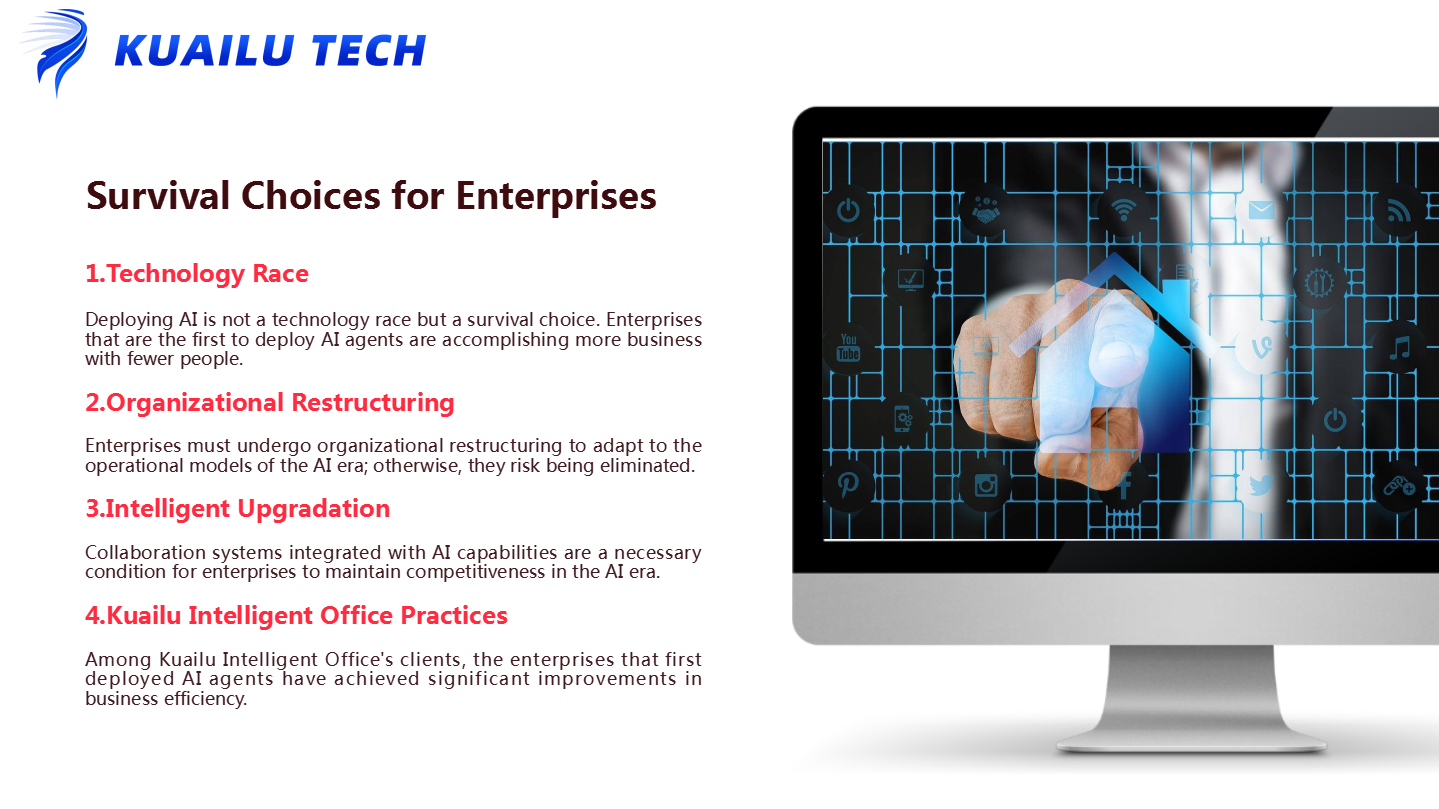 Among Kuailu's clients, early AI adopters are achieving more with fewer people. This is not a technology race—it is survival.
II. Most Companies Are "Using AI" the Wrong Way
For three decades, business meant humans enslaved by software—employees forced to learn SAP, CRM, and ERP.
When AI arrived, companies treated it as "yet another tool to learn." This is the greatest waste of AI.
Kuailu takes the opposite approach: We make software learn human language. AI becomes your "digital employee," not you becoming AI's "operator."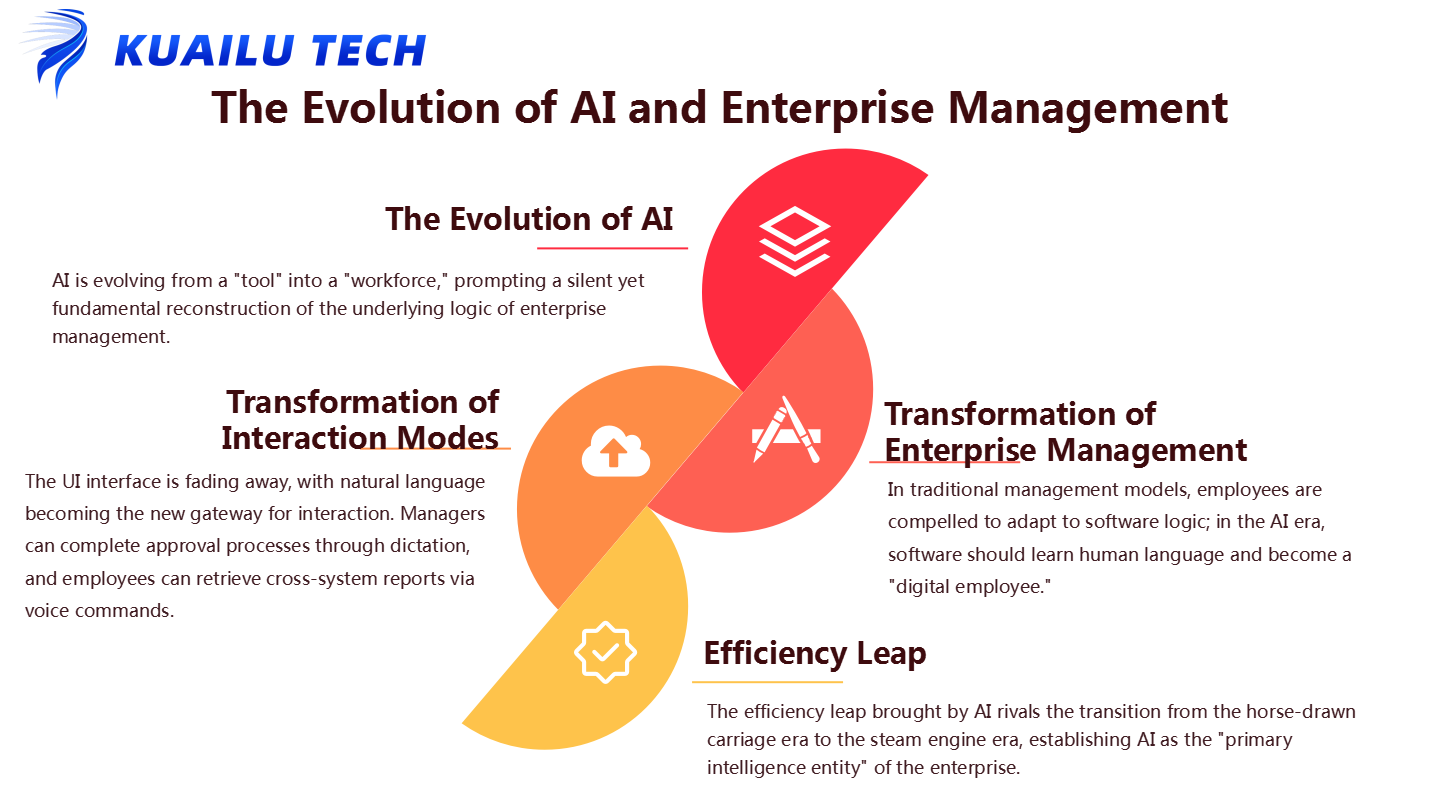 When managers can "dictate" approval processes and AI executes; when employees can "say" a command to pull cross-system reports—the UI is dying. Natural language is the new interface.
Thundersoft VP Yang Xinhui: "AI is becoming the 'first intelligence.'" The efficiency leap rivals moving from carriages to steam engines.
True "AI use" means the tool serves your business. If speaking solves it, why click a thousand times?
III. From SaaS to Service as Software
Salesforce CEO Marc Benioff defines today's shift as "Software as a Service (SaaS) to Service as Software (SaSo)." He asserts: "Today's CEOs are the last generation relying solely on human labor."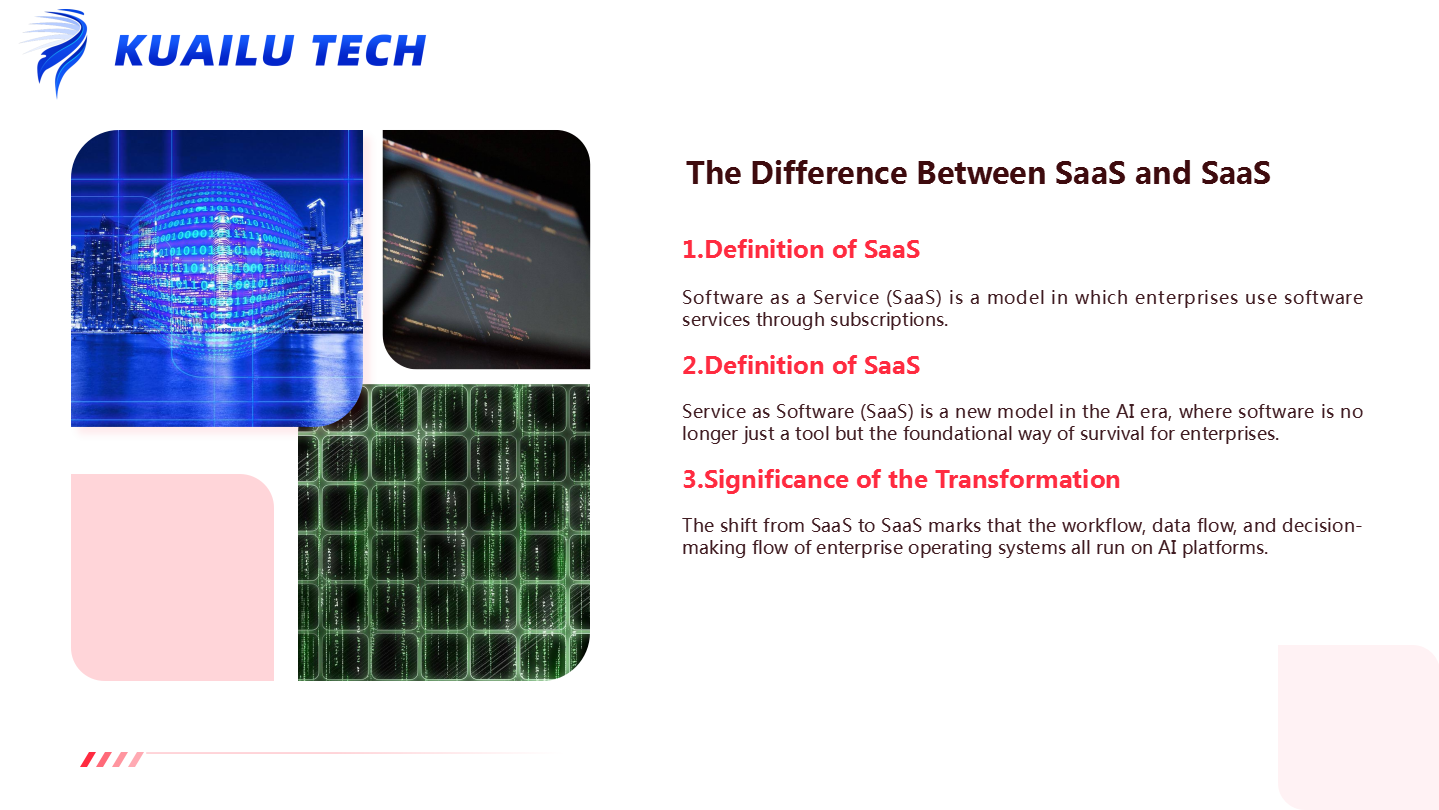 This is what Kuailu builds: not better software, but the enterprise OS for the AI era. When all processes run on Kuailu, AI transforms from feature to foundation.
In three years, companies that cannot "use AI" will lose not because of tools, but because of DNA.
IV. When AI Replaces Middle Management, What's Left?
When AI calculates win rates in 30 seconds, warns of churn, and compares supplier prices automatically—how much of managers' experience remains irreplaceable?
Microsoft CEO Satya Nadella: Human value lies in transforming judgment into an AI-irreplaceable competitive edge. The key is not finding the "best model," but knowing how to "orchestrate" AI.
Managers are left with two things: setting goals (value judgments) and handling exceptions (uncertainty).
Future managers are no longer "referees"—they are "legislators" and "emergency commanders." Management shifts from "process control" to "goal and value governance"—the only way forward: becoming "business philosophers."
V. Leaders' New Roles: Coordinators, Philosophers, Paradox Navigators
In the AI era, the CEO's role is reshaped:
First, become "AI coordinators" —defining what to automate and what needs foundation.
Second, become "business philosophers" —every AI system silently answers value questions: Which customers get priority? How is performance measured? These judgments, once embedded, are amplified.
Third, become "paradox navigators" —AI pursues speed and quantification, but true differentiation comes from creativity, gray areas, and long-term trust. The question is how to preserve the "inefficient" spaces crucial for the future.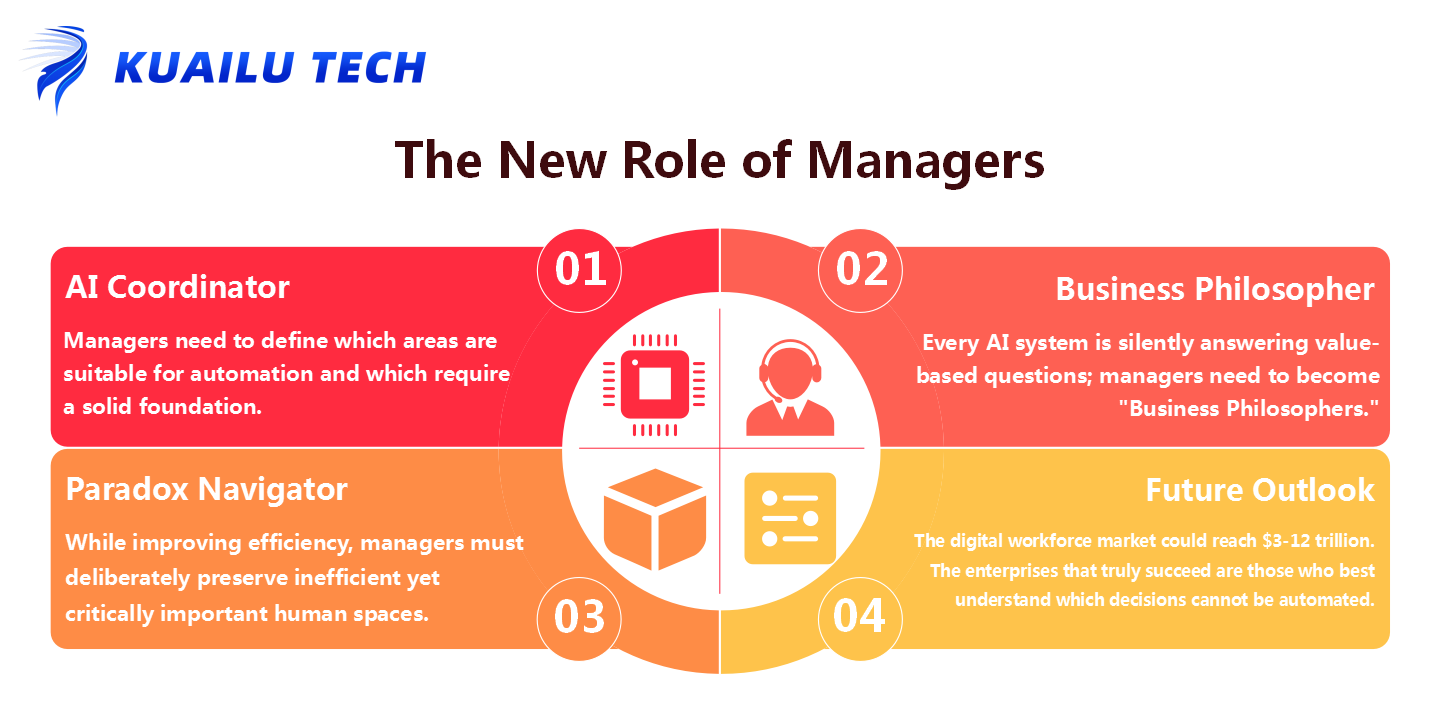 VI. Kuailu's Answer: Bringing "Using AI" Back to Essence
Nadella: "AI adoption requires transformation across 'mindset, capability, and data.' "
This is what Kuailu does: help enterprises build "AI-native operating systems" —turning dormant data into AI nourishment; transforming mechanical work into value co-creation with AI.
Let "using AI" return to essence—not employees adapting to AI, but AI adapting to your business; not AI becoming a learning burden, but AI becoming invisible productivity.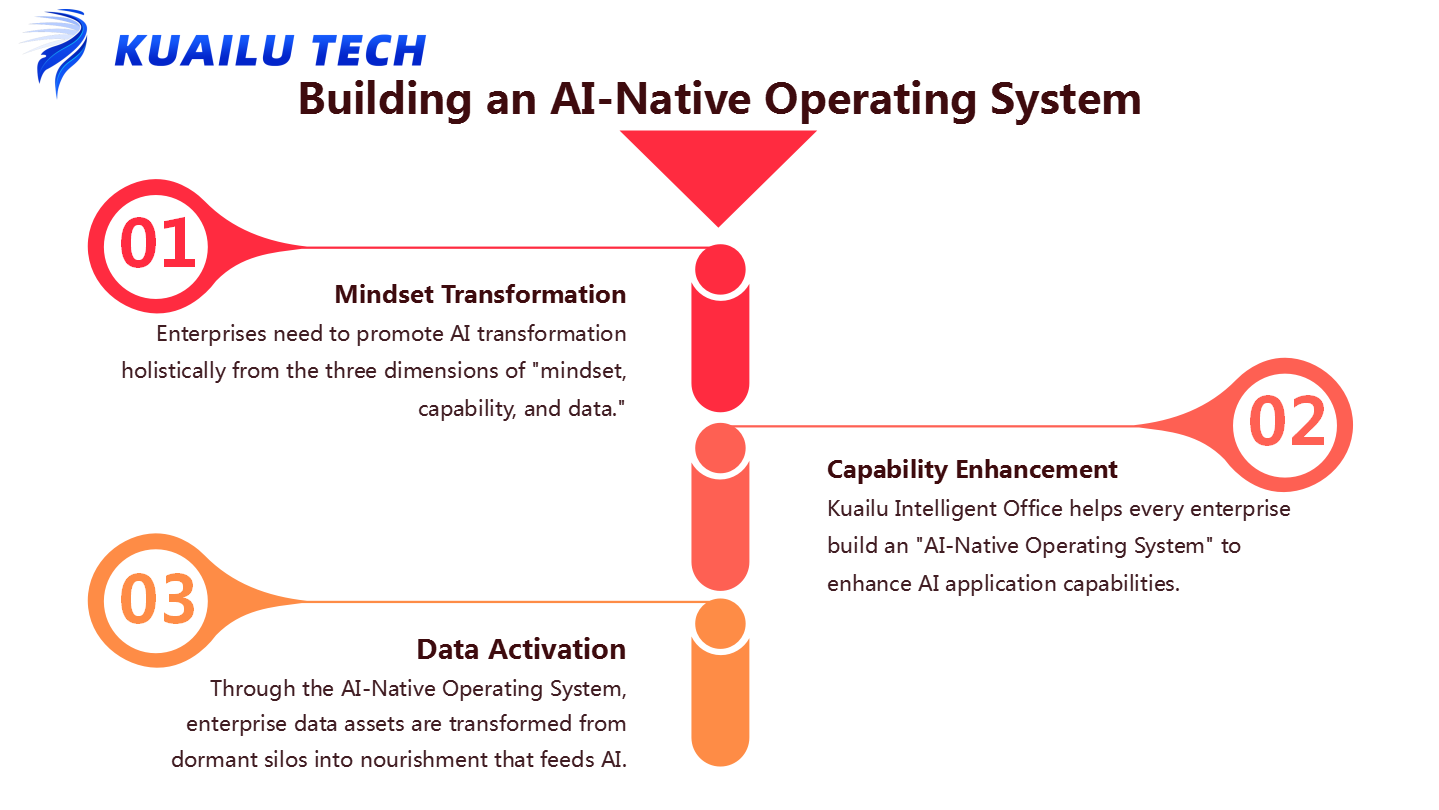 Companies adding "steam engines to carriages" will be crushed by real trains. Those embracing "human-machine collaboration," delegating decisions to AI agents, and letting software adapt to humans will occupy the top niches.
AI will not eliminate companies, but AI-using companies will eliminate those that don't. Kuailu highlights a deeper layer: AI-using companies are also eliminating those that "only use AI to write weekly reports."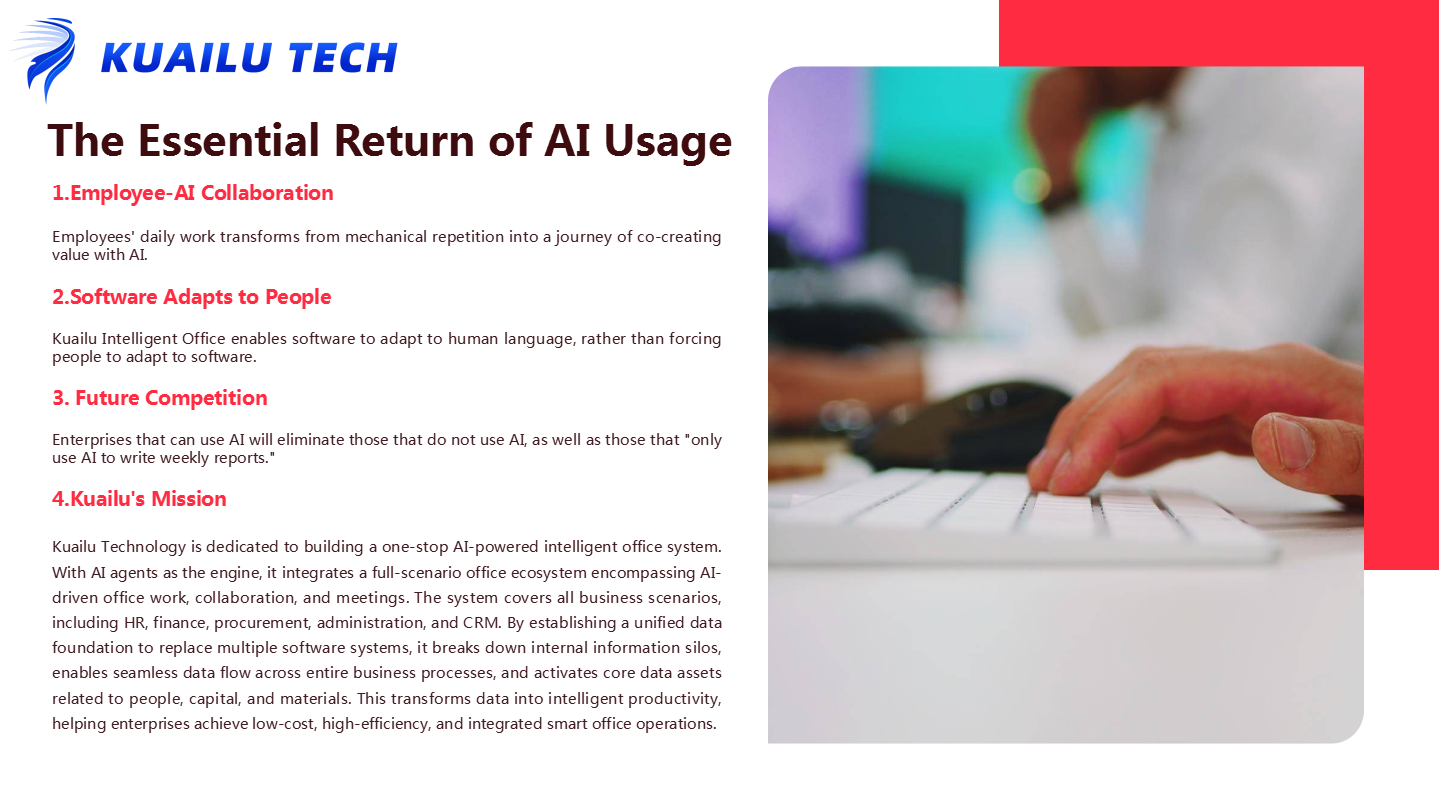 This is the true generational gap—the line between life and death.
Kuailu Intelligent Office lets "using AI" take root in Chinese enterprises' reality—helping every company find its path to survival in the AI era.