



KuailuTech CEO Luo Weiwei: Breaking Down Data Silos Is the Only Way to Truly Implement AI in Enterprises
【The Undercurrent Beneath the "Shrimp‑Farming" Craze】
In the spring of 2026, the nationwide "shrimp‑farming" craze gave countless people their first hands‑on experience of "AI working for humans".
News reports showed nearly a thousand people lining up with their laptops outside Tencent's headquarters in Shenzhen, waiting to install Open Claw. On social media, "raising lobster bots" became the new buzzword after "large language models".
Behind this frenzy of individual players, a truly profound transformation is taking place inside enterprises – AI is no longer just a "chatbot" but is becoming a "digital employee". KuailuTech, which focuses on one‑stop AI‑powered intelligent office systems, is turning this trend into a deliverable solution.
A deeper question is emerging: when AI can truly do the work, how should enterprises and individuals respond to this change?
【In the AI Era, SaaS Companies Face More Opportunities Than Challenges】
Software companies were among the first to feel the impact of AI. In response to the Wall Street mantra of "SaaS is dead" – that AI will shatter the moat of the software industry – Luo Weiwei disagrees. He believes that in the AI era, SaaS companies have more opportunities than challenges.
He reviewed the evolution of the software industry: from the traditional software era to the SaaS era, and now to the AI era. Technological changes have altered product forms, but the core value has not disappeared.
"After SaaS emerged, the traditional software leaders all transformed to the cloud. Today they are still the largest software companies in China. Just because the cloud era arrived doesn't mean their traditional software capabilities lost value. On the contrary, the customers, data and industry insights they accumulated over the years have helped them increase revenue five‑fold or more."
Luo Weiwei concluded:
"Underlying industry understanding is more important than technology, and the next most important thing is to seize the technological dividend."
A deep understanding of business operations and accumulated experience in industry scenarios are hard currency that can transcend technology cycles. SaaS companies will not disappear, but their form will change – from selling modules and accounts to selling outcomes and agents.
Jensen Huang famously said that AI is a user of tools, not a destroyer of tools. It will not reinvent a screwdriver; it will just pick up the existing screwdriver and use it.
Luo Weiwei strongly agrees:
"SAP has 200 million lines of code. The cost of fully AI‑ifying it would be huge. AI can just use SAP directly – why rewrite SAP?"
Nevertheless, because this round of technological disruption has leveled the playing field, software companies will stop competing solely on market coverage and feature depth and will instead return to the same starting line, participating in the new infrastructure project of implementing AI in enterprises. KuailuTech is one of the pioneers in this infrastructure project.
【Breaking Down Data Silos to Make Enterprise AI Easier】
AI is already flowing smoothly in personal applications, but its adoption in enterprises lags far behind. Apart from security risks and industry‑specific knowledge barriers, a deeper reason is that past systems were built in silos, data is fragmented, and AI lacks the soil to grow.
In the AI era, data is the most core asset of an enterprise. Whoever can break down data silos and make data flow will seize the initiative in the new industrial order.
"In the past, regardless of company size – small ones might have five systems, large ones might have one or two hundred systems."Luo Weiwei said that at least 30% of a company's annual IT investment goes into data integration and interfaces between systems.
The deeper cost is hidden – financial data in the finance system, HR data in the HR system, production data in the production system.
"If you want to analyse 'how many people do I need to generate how much revenue, and to what extent can production support it', all the data is disconnected."
In the AI era, this issue becomes critical. The three core elements of AI are computing power, models, and data. For most enterprises, they cannot build their own computing infrastructure, nor will they develop their own models. Their most core asset is their data. If the data cannot be connected and used, the most valuable asset remains locked at the bottom of a chest, unable to enjoy the AI dividend.
Luo Weiwei sees a fundamental bottleneck in the AI upgrade path of traditional software vendors.
"A company might be using four systems today: Kingdee, Yonyou, SAP, Salesforce. If I want to use AI capabilities, Kingdee upgrades, Yonyou upgrades, SAP upgrades – but all the AI capabilities remain inside their respective systems. SAP's AI cannot call Kingdee's data for a cross‑system analysis."
Facing this dilemma, KuailuTech's solution is: break through heterogeneous systems, centralise the data at the infrastructure layer, clean and structure the data, and then add an AI capability layer on top. The company's original systems can remain untouched.
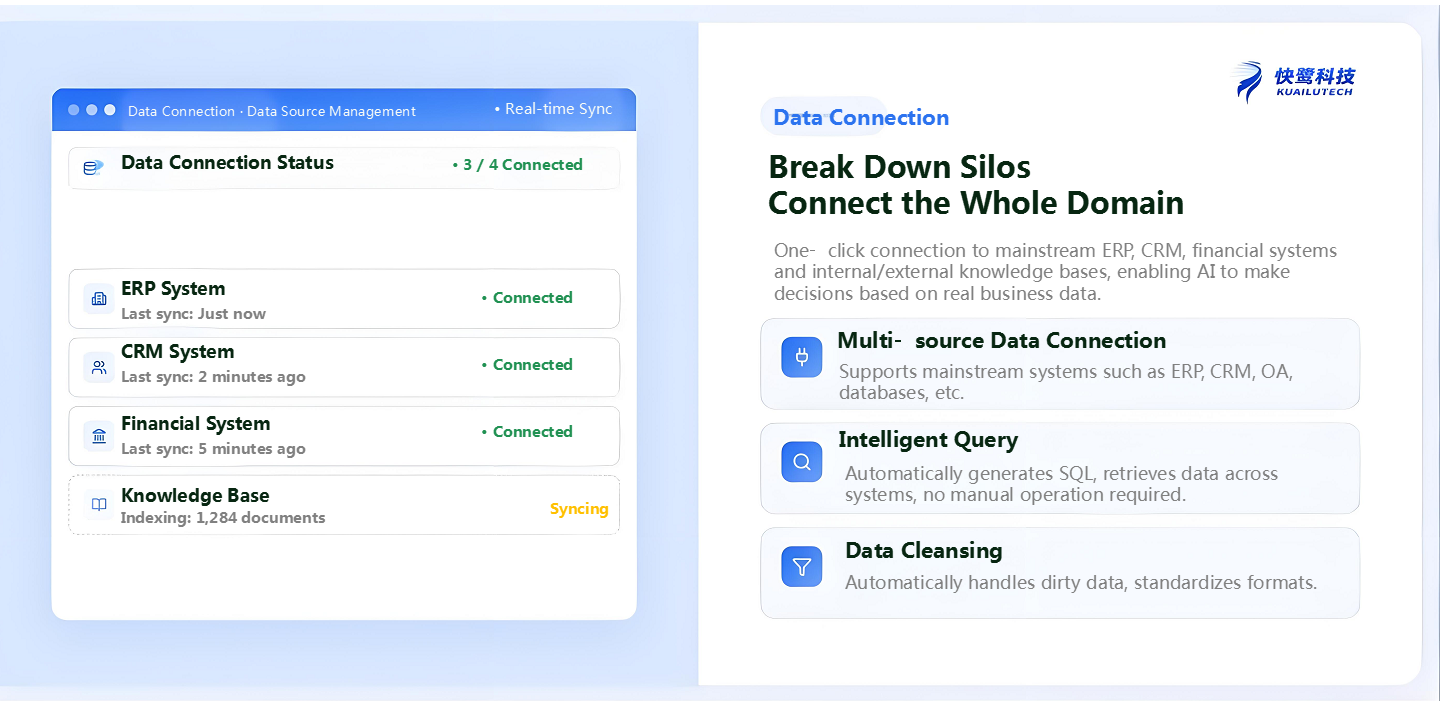
What can this layer achieve? Based on the data from the original systems, it enables cross‑system data queries, data analysis, and data applications, providing a basis for strategic decisions. Financial data, HR data, production data – originally locked in different silos – are now connected, and data can flow.
"In the past, customised systems cost at least five to ten times more than buying standard products. But with AI empowerment, product development costs have plummeted. So in this era, we can leverage the AI dividend to provide enterprises with one‑stop AI‑powered office solutions."
With lower cost, lower risk, and faster speed, enterprises can enjoy AI solutions.
【Turning "AI Capabilities" into "Digital Employees"】
Connecting data is only the first step. Once data flows, KuailuTech wants to let AI do the work directly. KuailuTech answers the question "how can AI do the work" with two products.
Product 1: AI Domain Expert – A "Mature Backbone" That Enterprises Can Trust
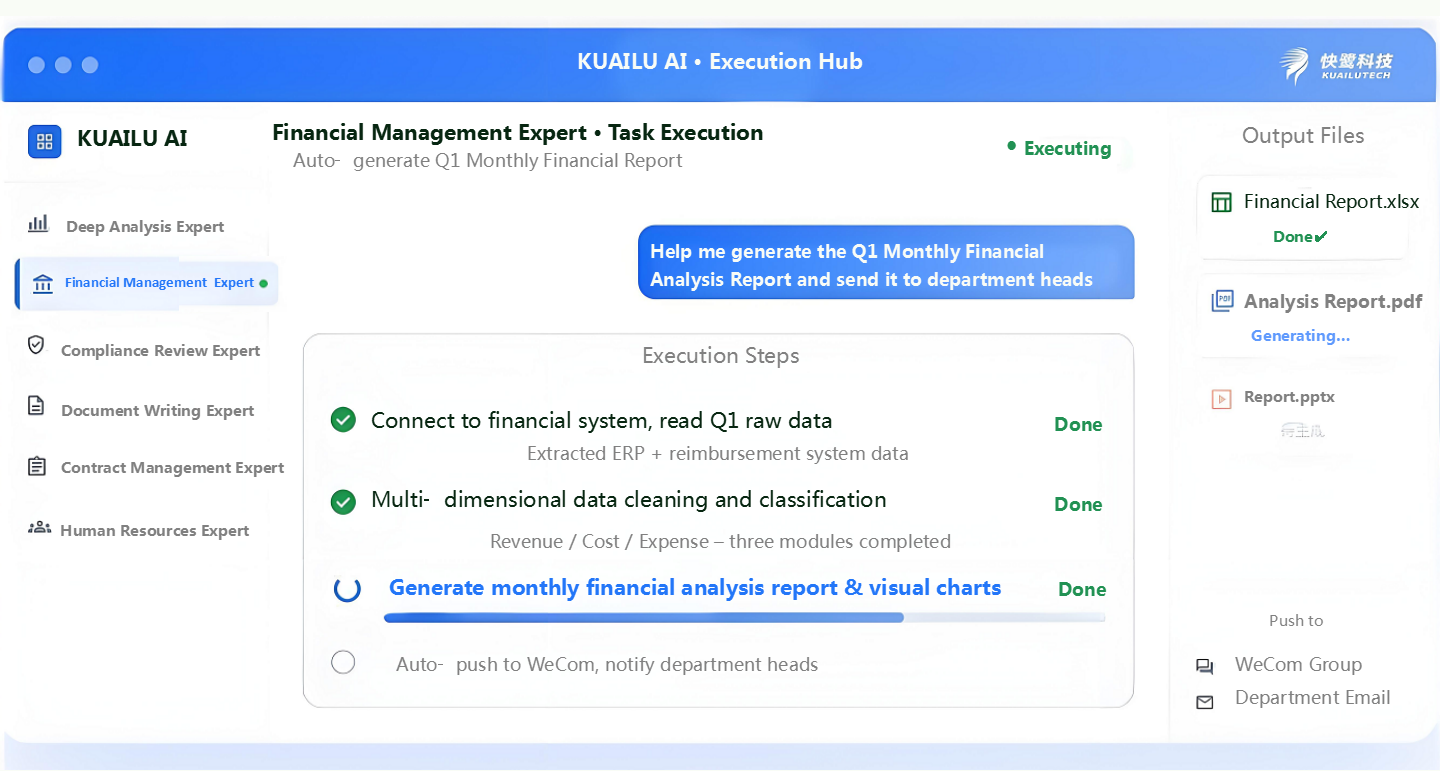
KuailuTech's "AI Domain Expert" product can solidify commonly used business processes into deterministic agent capabilities. The results are predictable, auditable, and traceable.
📌 Case Study: Automated Procurement Agent
Set up: "When inventory falls below 15%, automatically initiate a purchase requisition → proactively request quotes from suppliers → filter according to evaluation criteria → present to leadership for decision → issue purchase orders → monitor incoming goods" – in the past, this required coordination across multiple roles: warehouse, procurement, finance, etc. Now it is encapsulated into one agent, runs automatically, and delivers deterministic results.
"Customers can use it with confidence because they know what this AI is doing, and the results are predictable and auditable."What enterprises need is a high degree of certainty – an "AI they can trust to do the job".
Product 2: Kuailu CLAW – A "Rookie with Potential" That Enterprises Can Nurture
Kuailu CLAW is an "enterprise lobster bot". The two biggest differences from the "lobster bots" on the market are:
First:it is "one enterprise lobster bot", not one per person. The popular personal‑assistant‑type agents – each with its own style and customisation path – are costly, cannot reuse capabilities, and amplify security risks without limit. The enterprise version is designed with a different logic: capabilities are accumulated at the organisational level, and each person only invokes modules from that shared capability library.
Second: Kuailu CLAW has an added "capability circle" that limits the operational boundaries, avoiding the risk of "AI going rogue and deleting the database". This addresses the issue of "usable and growable" – moving enterprises from "using AI" to "customising AI".
The core mechanism of Kuailu CLAW is "learn – solidify – reuse". Luo Weiwei uses an analogy of "travelling to Beijing":
"The first time you go to Beijing, you need to analyse whether to fly or take the train, which flight is suitable, etc. After a lot of analysis, you reach a conclusion. The second time, you know you definitely won't walk – flying is fastest. Your habit is to go in the morning, handle business in the afternoon, and return in the evening. Every subsequent time, you follow a fixed process."
When the user tells it what to do in natural language for the first time and confirms the result is OK, this capability is stored as a "Skill" in the system. For every subsequent operation, it follows a standard procedure. Enterprises can define for themselves what kind of working patterns they want AI to help them form.
Luo Weiwei says:
"Kuailu CLAW is more like a fresh university graduate with a lot of possibilities. After entering the company, you can teach it to do finance, teach it to do HR. Once cultivated, it becomes a finance expert suited to your company, an HR expert suited to your company."
If we were to distinguish the two products in one sentence: the "AI Domain Expert" is a "ready-to-use mature employee" with deterministic and auditable results; while "Kuailu CLAW" is a "trainable rookie with potential" that grows with the business and changes as needed.
The capabilities of the two product lines can be shared:
"The 100 capabilities accumulated by the AI Domain Expert can all be imported into Kuailu CLAW, so that the enterprise not only has those 100 capabilities but can also define its 101st capability."
For enterprises that are still waiting and watching, Luo Weiwei's advice is:
"Enterprises don't need to fully AI‑ify everything right now, but they must start experimenting and making choices as early as possible."
【The Future Organisation: One Person Leading 10 AI Employees】
When enterprises can customise AI capabilities through products like "AI Domain Expert" and "Kuailu CLAW", the shape of the future organisation will also change.
"A term that has been popular in the market over the past two months is 'One Person Company'. Internally, we also have a term called 'TPD' – a two‑person development team. In the past, a development project required a team of at least five to ten people. Now two people can complete a medium‑sized system in five days."
Behind this is a fundamental organisational transformation:
"All organisations will become flatter and more agile in the future. Every employee in the future will be a super‑employee – one carbon‑based person leading ten silicon‑based people, one employee working together with ten AI employees."
Company size will also change:
"In a 50‑person company, if each person brings ten agents, you can basically accomplish what a 1,000‑person company used to achieve."
An even deeper change is the reversal of the way we work – from "humans adapting to tools" to "tools adapting to humans". The "interface" of office software may disappear, replaced by a powerful "database + AI logic layer".
The core competitive advantage of the future will shift from "how to execute" to "how to define". People who can ask good questions, formulate good problems, and gradually use AI to find answers will become the most scarce talent.
"Right now, the big AI companies are all competing for liberal arts graduates," Luo Weiwei said. "In the past, the saying was 'good at maths, physics and chemistry, and you can go anywhere in the world' – science majors had an advantage. But now, people who have understanding and accumulated knowledge in a certain domain, and who can articulate and express well, will become even more important in the AI era."
【From "Being Born for Tools" to "Creating with Tools"】
"Who will be replaced by AI?" is the most anxiety‑ridden question today. KuailuTech CEO Luo Weiwei's judgment is clear:
"Positions that are easy for AI to define and understand, and that can be turned into agent capabilities, have a relatively high probability of being replaced in the future."
He gives two examples. In government departments, the role dedicated to checking document formats and typos is disappearing – "they are not responsible for the content, only for the presentation. Such roles are very easily replaced by AI." In multinational companies, in the past every company needed a large legal team of lawyers familiar with the laws of various countries. Now a contract agent can check laws across multiple countries and automatically review whether a contract complies with local regulations. AI remembers legal provisions better than humans, and the law itself is entirely public data.
These cases reveal a pattern:
"The criterion for replacement is 'definable and encapsulable'."As long as the work of a role can be broken down into clear steps, understood by AI, and encapsulated into an agent, it stands on the edge of replacement.
Those roles that "exist for the sake of using tools" will also be replaced by AI. Luo Weiwei captures the essence in one sentence:
"In the past, many people were born for the purpose of using tools. Their job existed solely to use that tool."
From knotted cords to keyboards and mice, humans spent five thousand years learning "to use tools". We learn Excel, we learn PowerPoint – humans learn for the sake of tools, exist for the sake of tools, and even create specialised jobs for the sake of tools. When AI finally learns "to adapt to humans", when tools finally learn "to understand human language", the logic behind the existence of these roles is being completely overturned. But this is not a reason for panic; it is the beginning of liberation.
AI will free humans to do what only humans can do: define problems, create value, make judgments. And this is precisely the answer that KuailuTech is trying to deliver through "AI Domain Expert" and "Kuailu CLAW" – not replacing humans with AI, but making AI an "amplifier of human capability".
【Conclusion: Seizing the AI Window of Opportunity】
So, how can enterprises seize the "AI window" over the next three years? When every employee becomes a super‑employee, when the capability boundary of one person is expanded tenfold or a hundredfold by AI, how can the capability boundary of the enterprise be expanded? How can the value it creates grow?
The answer to these questions may not lie in more powerful AI, but in a more ancient variable:
Human imagination.
That is the true dividend of the AI era.